Author of Finding Lights in a Dark Age, Saying NO to a Farm-Free Future and A Small Farm Future
Menu

Hi, and welcome to my site. I’m an author, small-scale farmer and sometime academic social scientist, writing about this moment of vast change as the dynamics of climate, energy, politics and natural ecosystems upend familiar assumptions about how the world is supposed to work. I’ve written two books, numerous articles and a long-running blog that looks at all this from a variety of angles, but mostly grounded in the belief that we need to develop low-energy localisms that give people the means to make a practical livelihood from their surrounding ecological base – a small farm future, the title of my first book.
Do have a look around my site, and contribute to the discussion if you wish.
Please note that although my blog is long-running, this is a new site as of June 2023 and there are parts of it that I’m still building, so you may find that the content is cursory in places.
Chris
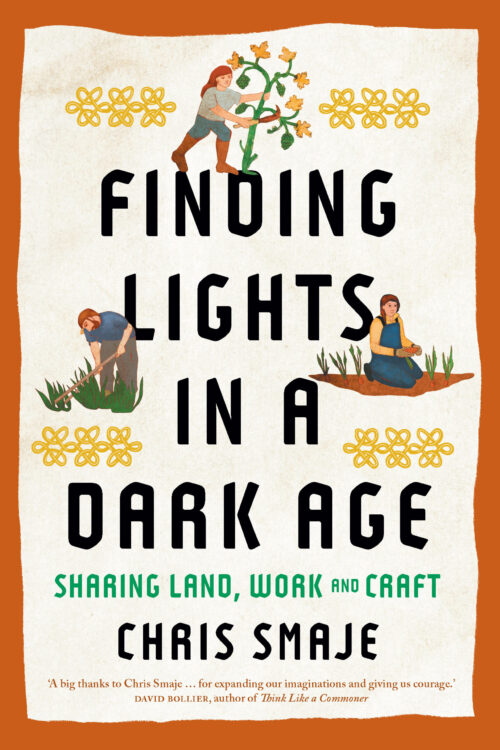
Finding Lights in a Dark Age
Sharing Land, Work and Craft
‘The source of our collective insecurity has its roots in the land – and has erected fences to keep us out. Chris Smaje’s erudite and compassionate investigation shows that our own wellbeing cannot be secured without Earth’s. He offers a vision for how we, the people, can secure our future by giving the labour of our bodies to the land and to each other. In a time of warring narratives, Smaje’s call for sovereignty invites us to tear down the fences that exile us from our own histories.’
Rachel Donald, creator and host, Planet: Critical podcast
My new book Finding Lights in a Dark Age is being published in the UK in October 2025 and the US in November 2025. Global society is unquestionably heading into a period of grave crisis, when the modernist gods of state and market, left-wing and right-wing, will need to be abandoned. …
‘The source of our collective insecurity has its roots in the land – and has erected fences to keep us out. Chris Smaje’s erudite and compassionate investigation shows that our own wellbeing cannot be secured without Earth’s. He offers a vision for how we, the people, can secure our future by giving the labour of our bodies to the land and to each other. In a time of warring narratives, Smaje’s call for sovereignty invites us to tear down the fences that exile us from our own histories.’
Rachel Donald, creator and host, Planet: Critical podcast
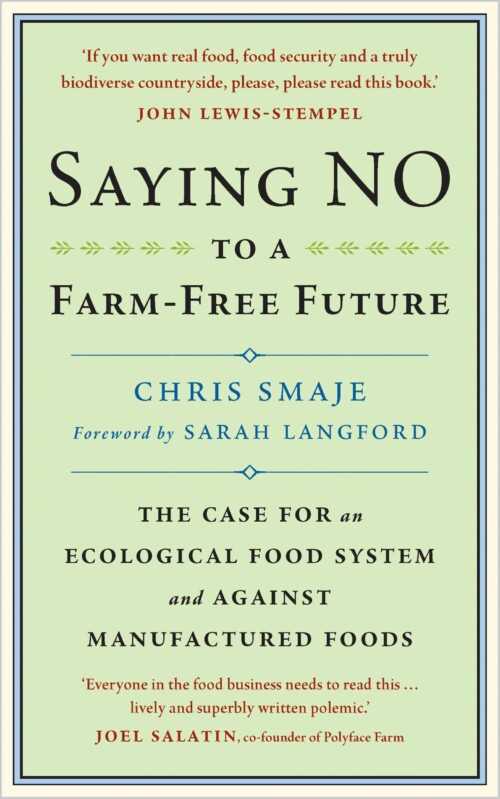
My new book, critiquing food techno-fixes and making the case for local food systems
The Case for an Ecological Food System and Against Manufactured Foods
“Everyone in the food business needs to read this book. If you think the future rests in time-tested local authenticity, Smaje’s arguments sound like affirming angels. If you think the future lies in techno-sophisticated urban manufacturing plants, you owe it to yourself to learn the best arguments from the opposing view.
For many of us in the local authentic food space, George Monbiot is our nemesis in the public debate of food’s future. Will it be local, democratised and heritage driven, or will it be manufactured by techno-sophisticates suddenly converted to humble, charitable ends? Smaje cuts precisely and directly, eviscerating Monbiot with superb and quotable verbalese.
Never have I enjoyed reading a blow-by-blow narrative as much as this lively and superbly written polemic.”
Joel Salatin, co-founder of Polyface Farm, and author of You Can Farm and Polyface Micro
One of the few voices to challenge The Guardian’s George Monbiot on the future of food and farming (and the restoration of nature) is academic, farmer and author of A Small Farm Future Chris Smaje. In Saying NO to a Farm-Free Future, Smaje presents his defense of small-scale farming and a robust critique of …
“Everyone in the food business needs to read this book. If you think the future rests in time-tested local authenticity, Smaje’s arguments sound like affirming angels. If you think the future lies in techno-sophisticated urban manufacturing plants, you owe it to yourself to learn the best arguments from the opposing view.
For many of us in the local authentic food space, George Monbiot is our nemesis in the public debate of food’s future. Will it be local, democratised and heritage driven, or will it be manufactured by techno-sophisticates suddenly converted to humble, charitable ends? Smaje cuts precisely and directly, eviscerating Monbiot with superb and quotable verbalese.
Never have I enjoyed reading a blow-by-blow narrative as much as this lively and superbly written polemic.”
Joel Salatin, co-founder of Polyface Farm, and author of You Can Farm and Polyface Micro
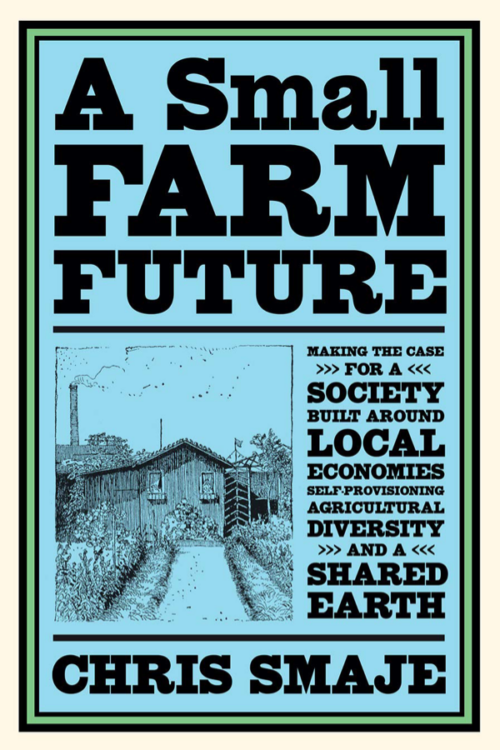
My first book
Making the Case for a Society Built Around Local Economies, Self-Provisioning, Agricultural Diversity and a Shared Earth
“We are facing an existential crisis with species extinction, climate catastrophes, desertification of soil, disappearance of water, pandemics of infectious and chronic diseases, hunger and malnutrition. Industrialized, globalized agriculture based on the myth that it feeds the world is driving the multiple, interconnected crisis. Eighty percent of the food we eat comes from small farms. Chris Smaje s A Small Farm Future shows that the choice is clear. Either we have a small farm future, or we face collapse and extinction.”
Vandana Shiva, author of Oneness vs. the 1% and Who Really Feeds the World?
From the back cover: “A Small Farm Future is a ground-breaking debut, destined to become a modern classic – planting a flag at the intersection between economics, agriculture and society during a time of immense crisis. Farmer and social scientist Chris Smaje makes the case for organising human societies around small-scale, …
“We are facing an existential crisis with species extinction, climate catastrophes, desertification of soil, disappearance of water, pandemics of infectious and chronic diseases, hunger and malnutrition. Industrialized, globalized agriculture based on the myth that it feeds the world is driving the multiple, interconnected crisis. Eighty percent of the food we eat comes from small farms. Chris Smaje s A Small Farm Future shows that the choice is clear. Either we have a small farm future, or we face collapse and extinction.”
Vandana Shiva, author of Oneness vs. the 1% and Who Really Feeds the World?

I’ve been blogging about farming, ecology and politics since 2012. I welcome well-tempered discussion. Please note that if you’re a new commenter, or if you include a lot of links, your comment will go into the moderation queue before publication. I sometimes miss comments in the queue so feel free to nudge me via the Contact Form if your comment fails to appear.
Posted on October 10, 2026 | 34 Comments
Another book review while it’s fresh in my mind, this time Luke Kemp’s Goliath’s Curse: The History and Future of Societal Collapse (Penguin, 2025). As is my wont, I’m going to spend more time talking about what I disagree with in the book than what I agree with, because I find it more generative. But let me begin with a quick summary of its merits, which are considerable. First of all, it’s just really great to see a young scholar with highfaluting academic credibility taking the idea of emerging societal collapse seriously. Despite the ever-growing drumbeat of warning signals, it …
Continue readingPosted on September 22, 2026 | 54 Comments
I mentioned that I was going to reproduce my article in The Land 37 here. Well, it’s coming right up below (it was published in The Land with the title ‘Rentiers Redux’). The article is essentially a review of Nick Bano’s book Against Landlords, albeit with some wider analysis and context. I’ll probably sketch in a bit more of that context, either in the comments section below or in a follow-up post. Meanwhile, to update another semi-regular feature of this blog, here’s my current/recent reading: Luke Kemp Goliath’s Curse: The History and Future of Societal Collapse Lyndal Roper Summer of Fire and Blood: The German …
Continue readingPosted on September 4, 2026 | 11 Comments
Following my obituary for The Land magazine in my previous post I’d intended to publish in this next one my article on landlordism that appeared in the final issue. Instead, it turns out that another obituary takes precedence – in this case for Wendell Berry, who died last Sunday. There are others better placed than me to give a proper account of his life and work. Here, I’ll just make a few personal remarks which I hope might serve, however inadequately, as an act of remembrance. I became an adult in the 1980s, at least in the quantitative sense of …
Continue readingPosted on August 24, 2026 | 6 Comments
Just a short post to mark the passing of the great Land magazine, which has shut up shop with its 37th issue this summer. What can I say about it? For almost as many years as I’ve been following a more land-based way of life, The Land has been a guiding light for so many of the issues that matter to me – low-impact living and farming, access to land, poverty and inequality, climate change, nature and biodiversity, and the machinations of the anti-human and anti-nature juggernaut of the present global political economy. On all these issues, I often feel …
Continue reading
If you like my writing, please help me keep the blog going by donating!
 Subscribe via RSS