
Author of Finding Lights in a Dark Age, Saying NO to a Farm-Free Future and A Small Farm Future
Menu
Posted on November 11, 2025 | 60 Comments
To coincide with the US publication today of my new book Finding Lights in a Dark Age, I think it’s time to start writing some blog posts about it. I have a bit of unfinished business in relation to other projected posts, but hopefully I can sweep them up somewhere along the way. It’s going to be a slow tick over, though, because I don’t currently have much capacity to turn out blog posts at speed.
I’ll begin by linking something I mention at the very start of the book with something I mention at the very end.
At the start, I describe a process of climate change in early medieval times caused by volcanic activity which ultimately helped prompt the emergence of the Vikings as an expansionary and predatory force across an impressive stretch of the globe. I liken Viking society, both for good and (mostly) bad, to a gangster or pirate culture, with a code of honour that applies to its protagonists but not to its victims. This pirate culture, I argue, is a foundation of modern political culture more generally, even if its violence has often been more sublimated in recent times. People tend to forget this, assuming that violence outside an explicit social contract is just the inherent way of things. It is, for sure, one way that people have commonly done politics, and not only in medieval and modern Europe. But it’s not the only way, and this is worth remembering in our present troubled times. We’ve touched on this issue in recent discussions on this blog.
At the end of the book, I give an acknowledgement to Marshall Sahlins and David Graeber, anthropologists of the Chicago ‘anarchist school’, who were more influential upon me in the writing of it than I’d anticipated. But when I wrote Finding Lights… I hadn’t yet read Graeber’s book Pirate Enlightenment, or the Real Libertalia – perhaps slightly unfortunately in view of my opening piratical theme.
Pirate Enlightenment was, according to Graeber, originally written as a chapter for a book he co-wrote with Sahlins called On Kings, which I did read before writing Finding Lights… I drew on its analysis of stranger kings to try to make some sense of our baffling contemporary politics – again, something touched on in recent blog posts and discussions.
I won’t try to summarise Pirate Enlightenment here, but the mise-en-scène involves European pirates of the late seventeenth and early eighteenth centuries, who had originally been operating in the Atlantic and Caribbean, ultimately decamping to the northeast coast of Madagascar and settling. There, they were drawn into the complex political affairs of local Malagasy protagonists. In keeping with his wider project to take Euro-American self-importance down a peg or two, Graeber argues that the relatively egalitarian politics that emerged in this pirate-Malagasy encounter influenced the thinkers of the emerging Enlightenment back in Europe as they cast off the received wisdom of old hierarchies and developed modern conceptions of liberty.
I’m in no position to judge the truth of this claim. I suspect Graeber may have over-egged his argument a little here. But the more general point about how new culture and politics often emerges conjointly out of the encounter between indigenes and incoming strangers, especially relatively high-status ones with colonial designs, is interesting. It’s a point I made historically in my book A Small Farm Future using examples particularly from the colonial Caribbean of the slavery era – an especially brutal form of domination out of which nevertheless new local cultural synthesis emerged. In Finding Lights… I make the point prospectively, arguing that new forms of local agrarian politics and practice are likely to emerge in the future as people seek what I call ‘open country’ – places where the landscape, the waterscape and the peoplescape are suited as best they can be to a peaceful and prosperous life.
Contemporary discussion of such collapse scenarios seems to me often a bit too hidebound by existing political theories, or by ‘Viking’, ‘men with guns’, or Hobbesian thinking. In these collapse scenarios in open country, I write in Finding Lights… “neat pre-existing theories about the evils of landlordism, the benefits of land value tax, the nature of class struggle or the war of all against all are less to the point than how you configure new relationships on the ground. Right now, you’re unique participants in a complex drama of real human beings that you’re helping to write, not rote performers of old lines” (p.110).
I’m not suggesting the world will be turned upside down and the meek will inherit the earth. I pay plenty of attention in the book to the way that naked power might assert itself. But I do think Graeber-esque attention to the complexities of political power and the way it can shift as people navigate its contours in new circumstances is appropriate.
In that sense, arguably I paint too negative a picture of the Vikings in the book’s preface, because that complexity no doubt applied to them too. But what I’m trying to do in that preface is guard against over-breezy historical mythmaking of the Mussolini-made-the-trains-run-on-time variety: “Say what you like about the Vikings, they certainly boosted trade along the Dnieper”. Yeah, and in doing that, alongside all the slavery and death, they also tipped the scales that bit further against the possibility of ecologically wise localisms.
And so I still hold to the wider point I was making via the Viking example when I wrote “The trading-raiding-slaving nexus of Viking-era globalization is our world, directly paralleling the globalization of modern centuries” (p.xiii). In other words there’s a need, in contemporary parlance, to ‘de-colonise’ our assumptions about the present world of globalism and its forms of violence, hidden or otherwise. Although that process has its complexities and difficulties too, which perhaps I’ll touch on in another post.
Graeber points out that most European pirate crews in their seventeenth-century heyday were created out of mutiny against the brutal regimes aboard naval and merchant vessels. This meant certain death for them if captured, regardless of any piratical misadventures. The pirate flag often depicted an hourglass to symbolise this borrowed time and nothing-to-lose mentality. Pirates could often capture a lot of lucre, but – cut off as they were from the wider social connections that turned money into a flow of benefit – it was usually an empty form of plenty. Setting themselves up as stranger kings in Madagascar was one creative response.
Perhaps we who are now so connected in a global world of lucre are living in the mirror of such brutal and empty pirate worlds, the sand running unnoticed through the hourglass. Which I guess is why I feel compelled to keep writing books like Finding Lights… and to keep talking about this, because it’s a perspective that gets drowned out by too much celebration of a modernism and Enlightenment sanitised of its piratical ways.
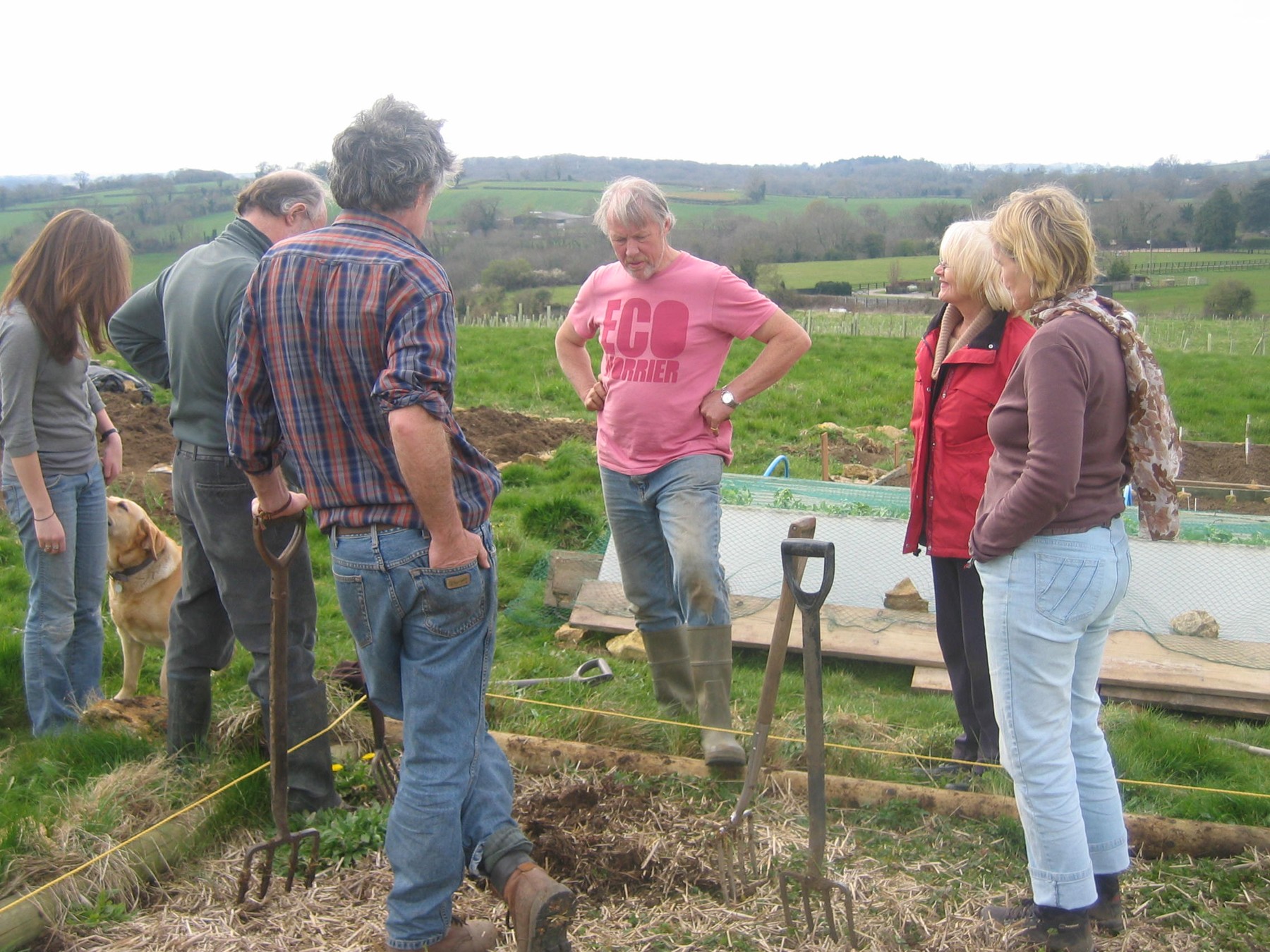
Anyway, a couple more points before I close. Talking of sand and hourglasses, I went to a memorial on Saturday for Des Harris, a steadfast townsman of Frome for many years who helped us greatly nearly twenty years ago when we were establishing our site and market garden. He also taught people gardening skills on the allotments we established on our site, as shown in this picture – Des resplendent in his Eco-Worrier T-shirt. I coined the phrase ‘Dig With Des’ for these sessions, which somehow stuck. Later he took a course with Charles Dowding just down the road and became a convert to Charles’s methods, so it became Don’t Dig with Des.
The memorial was a lovely, and crowded, event. Des touched a lot of lives with his commitment to serving the wider good. I fear that when I was in the throes of trying to establish a commercially viable market garden I sometimes exhibited a certain spikiness in his presence around things that seem unimportant now. Something of a character flaw, perhaps – although the tensions involved in being a community-minded local businessperson raise wider questions that I touch on in my book and that perhaps I’ll return to here in the future.
In the meantime, I’ll venture the opinion that the kind of community connections that Des sought to build through his life are more fruitful than anything the Vikings built along the Dnieper. In the words of Linda Ellis’s sweet little poem The Dash, which was read out at the memorial, “If we could just slow down enough to consider what’s true and real…” And not only in our individual lives. Ain’t that true of our modern, pirate world writ large.
Anyway, so long Des, and all good wishes for your onward journey. You were a great teacher, not just of gardening. And your dash was exemplary.
Finally, the first full-length of review of Finding Lights… that I’ve seen is in, from the pen of the ever thought-provoking Hadden Turner. Happily for me, it’s a positive one, which is always nice to see.
The only point Hadden makes that I’m inclined to unfold a little is this: “Chris is optimistic, and I wish I shared his optimism”.
I don’t mind that description, given that I’m more often characterized as an unrelenting doomer – although I prefer to go with ‘hope’ than ‘optimism’. In truth, I’m not massively optimistic that the new dark age will turn out too well for many people, but I think once one has appraised the reality of the surrounding darkness it’s always worth looking for the light as best one can and seeking least worst responses to our predicaments. Whether we find it or not is another matter. Perhaps the book should have been called Looking for Lights in a Dark Age.
Well, I’m glad it wasn’t. My preferred title was the more ambiguous Lights for a Dark Age, which also scans better. But we don’t always get what we want in life, a truth that I believe will soon be biting harder on a lot more people in the presently wealthy world. All eyes on the hourglass.

If you like my writing, please help me keep the blog going by donating!
 Subscribe via RSS
The hour glass immediately made me think of XR’s symbolism, and the rest of the piratical images, skulls and bones.
I’ve recently been listening William Dalrymple’s talks on his book, The Anarchy, a history of the East India Company, whose founding voyage was a great success – and a simple act of piracy! It is so interesting to see these histories criss crossing from creative liberators to corporate authoritarians but all ultimately detached from the day to day reality of the land folk, and land truth. The small farm, local agrarian future is deeply embedded in these truths and realities.
I’ve been reading Anastasia’s substackhttps://substack.com/@anastassiamakarieva
She is a coauthor of the Biotic Pump theory, which proves the action of primary forests as climate regulators and water sources for all continental life. Again, to preserve these forests will entail the structures of local agrarian community provisioning – to regenerate the currently degraded soils from industrial agriculture, agro and re forest, for fuel and timber, and live by skimming the flows of energy. The discussion of these facts only becomes more important, so thank you. Alice and I will be listening to the audio book, next up when we finish ‘Parable of the Talents’.
This is all very fascinating, of course.
I have just realized that when Plato spoke of “the good, the true, the beautiful” he had turned adjectives into nouns, and thus set much of the stage for the entire course of Western philosophy, its worldview. It took me too long to finally realize that syntax and grammar played such a fundamental role in shaping “our culture”. It would have been much better for the world if Plato and Aristotle were treated as grumpy old men rather than sages. If they had dealt in a world of adjectives more, and verbs, rather than nouns.
Kosmology was, I have discovered, basically booted out of the ancient and the modern academy (and Lyceum), replaced with “ontology”. So moderns still call relational kosmology by the misnomer of “relational ontology”.
It took me too long to realize that belonging is not so much a matter of ontology as kosmology, and that modernity had simply inherited the errors of grumpy old men.
But there we have it, my philosophy in a nut shell. We went wrong taking “the world” (kosmos) as a thing and a collection of things. We literally forgot how to belong together. Sigh.
‘We went wrong taking “the world” (kosmos) as a thing and a collection of things.’
Perhaps our error is in “taking” the world instead of “making” the world. Of course I am speaking as a grumpy old man myself.
In what sense do you imagine that we “make” the world, Walter?
When I say “world,” I mean both the natural world and culture/language/etc. — which is rare in non-reductive forms of perception, experience and thought. Modern science tends to be very reductive on such matters, because it lacks a relational kosmology. (As I see it.)
There are makers and there are takers. The makers put food on the plate; a plate they also made. The takers work the System to get money to buy food and plates. The takers usually get a better deal than the makers because the System is set up that way. But there are gradations among the takers too; for instance how much personal risk is involved. See my comment below. But if you are a maker you are “hors catégorie,” or beyond categories.
Everywhere I look, there you are. The more we run into each other, the more curious about you I become.
For some reason, Chris’ blog lets me reply to your first comment but not your (nested) later one.
In the latter comment, you speak of takers and makers. With all due respect to Daniel Quinn, I think it important to also mention leavers.
Robin – Takers and makers is an old bifurcation. Daniel Quinn just co-opted it in his Ishmael series. I don’t believe I was referring to Quinn at all in that comment. As someone who has actually studied primatology in college, I find the talking gorilla vehicle not only silly but stupid. And I did give Ishmael a try when it came out in the 1990s. I thought it wasn’t worth the paper it was printed on and quickly dropped it. I also went around and around with Tom Murphy on a couple of his blog posts – on Ishmael, Descartes, and the absurd notion that agriculture is “bad.” Murphy is a simplistic thinker and started by deleting some of my posts and then just canceled me. No problem. I have been fighting the lamestream for nearly 60 years so I am used to it. I no longer comment on Chris Smaje’s blog because there is no percentage in it. I started doing my Substack in January because: 1) I had followers on my comments on other blogs, 2) it was a good vehicle for my own writing, and 3) there was a possibility of getting people to shift their paradigms and devise their own. This is the purpose of my third book. As I go into the third month of my own writing on Substack, I am considering dropping that too. Electronic social media is a trap and the minuses are very close to outweighing the pluses. If people really want to work for change, there are opporunities right in front of them.
Yes ĵames, it is more properly descriptive to write ‘land ways’ as opposed to ‘land truths’, I am all about the embodiment if process, ecological, geological and biological and physical. I like your insight.
And another review:
https://www.resilience.org/stories/2025-11-11/finding-lights-in-a-dark-age-sharing-land-work-and-craft-review/
Chris – Since you asked me to comment on your new book, here is a preliminary assessment on the viking/pirate idea. Yes, I have often compared the corporate pirates of our day with the viking predilection to just go somewhere and take the gold and the slaves and even take the land and settle in for a good long while. But T. Boone Pickens, Jeff Bezos and all the rest of the corporate raiders are but pale shadows of the vikings. The current crop of raiders are weaklings who wouldn’t survive crossing the North Sea in an open boat. The corporate overlords nowadays just use their connections and inherited wealth to steal what they want – in a system already set up for them. As a side note, I was traveling on a ferry from Bergen to Newcastle once and we ran into a gale. The ship would ride a wave up and then smash down into the trough. The whole huge ferry would shudder at the impact. I loved it! I was up on the top deck on the bow, drinking beer, getting wet and hanging onto the rail. While I was up there a young Norwegian man came out on deck with his 2-3 year old daughter to show her the power of the sea. They didn’t stay long but his daughter was excited and laughing. When I came back into the cabin area again, the whole ship smelled like vomit. By the time we got to Newcastle, the storm had passed. The idea here is to provide a flavor of the harsh conditions of the real physical environment, just like you did in mentioning the volcanic eruptions of 536-540.
The “trading, raiding and slavery nexus” is a brilliant way to put it. It also fits into the tripartite division that was important back then – and still is today. (The viking sacred number 9 is simply 3 compounded upon itself. Taking 3 to the next structural level, as it were.) Georges Dumézil was a linguist and scholar who popularized the tripartite division of Indo-European mythology and languages, even though he was careful not to extend his analysis into a general categorization of culture. C. Scott Littleton did an essay on this in 1974 titled “Je ne suis pas … structuraliste”: Some Fundamental Differences between Dumézil and Lévi-Strauss.” I myself see the tripartite division as foundational even in our modern world. Indeed, doing things in threes keeps me out of trouble.
Right now I am traveling in the west of Norway. I needed a break from France, I haven’t been here since 1987, and I wanted to see the old country one more time before I shuffle off this mortal coil. It is quite fulsome just to breathe the air and drink the water. I like the laid-back aloof atmosphere. It is addictive.
Which brings me to my final point. There is a certain tendency among the Scandic types to just go along and not escalate in the “proper manner” like the people from other cultures. Then they just explode. This is rare of course, which is why it is codified in the berserker mythology. (The magic mushrooms trope is just crap from the 19th century, by the way.) By the time the sagas had progressed into high drama, like Grettir’s Saga, they had become almost comical. Which brings me back to the structural aspect of your pirate meme. People like Pickens and Bezos can become pirates because the System offers them the chance. Since they are opportunists they just use a system already set up for them. They don’t have to risk much, certainly not crossing seas in an open boat or dragging a trading vessel through long stretches of mosquito-filled forest to get to the next navigable waterway.
I have just started the book, but it is good so far.
I’m not suggesting the world will be turned upside down and the meek will inherit the earth.
Given what happened to the last guy who seriously suggested this, perhaps it’s for the best.
More seriously, though: having the upper hand in the trading-raiding-slaving world we live in, holding power over others and using it to our advantage and their detriment, does a sort of damage to human beings, I think. The likes of Bezos, Zuckerberg, Trump and Musk seem ultimately unhappy, even spiritually bereft in some way. And they’ll die like the rest of us, so what’s the point in storing up all those riches?
I like the idea of governance (and therefore politics) that doesn’t rely on violence or the threat of violence.
From Wikipedia:
“The trophic level of an organism is the position it occupies in a food web. Within a food web, a food chain is a succession of organisms that eat other organisms and may, in turn, be eaten themselves. The trophic level of an organism is the number of steps it is from the start of the chain. A food web starts at trophic level 1 with primary producers such as plants, can move to herbivores at level 2, carnivores at level 3 or higher, and typically finish with apex predators at level 4 or 5. The path along the chain can form either a one-way flow or a part of a wider food “web”. Ecological communities with higher biodiversity form more complex trophic paths”.
Organisms killing and eating other organisms is certainly violent. If interactions between trophic levels always includes violence, it is hard to imagine a living world without it.
There is, of course, lots of inter- and intra-species cooperation, too, but as long as there are trophic levels and trophic cascades, there will always be violent competition. We shouldn’t be surprised that humans, as apex predators, engage in it.
That said, no organism, including me, likes to have violence applied to it and always tries to avoid being subject to violence. Violence is natural, but even though that doesn’t automatically glorify it, we shouldn’t be surprised that it happens.
I think the conflation of trophic biological and animal processes and behaviours that work within ecological boundaries and frameworks to baseless acts of human aggression (genocidal and ecocidal) is a slippery slope my friend. These acts are rooted in layers of propaganda and necessarily take place in communities displaced from ecological context which constrains such behaviours. Simply put, it is the disconnection from ecological trophic structures which allows for this type of human violence that Kathryn is willing us to avoid.
I have noticed that the roughly twenty missiles fired upon mostly Venezuelan boats in the Caribbean over recent months resulted in dead bodies which were not eaten by those who fired the missiles. And the vast aircraft carriers and other military apparatus set up to invade Venezuela is not there for a feast of flesh.
I just learned that China has intervened! Wow!
Trump and his friends are out of their bloody gourds.
PS –
I guess I read too much into a headline there in saying that China was intervening. I assumed that meant that China was sending its own aircraft carriers to the region.
You might want to consider John Mearsheimer’s paradigm of regional hegemony. The US had a brief fling with global hegemony in the “Unipolar Moment” from 1991 (fall of the Soviet Union) to either 2001 (9/11) or 2022 (Biden’s reneging on foreign assets stored in the US), but it is clear we now live in a multipolar world. The Trump Administration sees this and has pivoted away from Asia and Europe to focus on the western hemisphere. I suspect China is okay with this and will let the US get away with seizing Venezuelan oil for multinational corporations. The Iraq model, as it were, but without Bremer’s mistakes.
Where does most of Iran and Venezuela’s oil end up?
China
If the US wants to “hobble” it’s biggest geopolitical rival, then cut off China’s access to the world’s oil.
I don’t think the USA is shoring up it’s influence locally in Venezuela. It’s still acting globally to try and maintain it hegemony.
John Adams – Let’s see how it plays out. The Chinese independent refiners will likely pivot and continue to buy from Venezuela even after the US controls the oil. The state-owned firms will just continue under sanctions like they have done since 2019.
China seems to be applying “top-down decentralization,” to use a rather clunky phrase. A good example is encouraging its citizens to buy gold “beads” as a savings tool. The young Chinese seem to love it. This creates markets and brings more gold into the national borders. And it provides more markets for gold mined in China and even encourages buying up gold doré around the world.
It has not been lost on me that the Panama Canal kerfuffle has dropped out of the news cycle. Probably because the Chinese companies actually get the day-to-day job done of shipping. I suspect that after the US seizes the Venezuelan oil, it will still be sold to independent Chinese refiners. The US Gulf Coast refiners just won’t be able to handle it all. Especially when the bbl/day increase.
@Walter Haugen
Rare earths are important but oil is the “apex resource”.
Whoever controls oil controls the world.
Regime change in Iran and Venezuela……………been here before.
John Adams – You are correct that oil is the apex resource. The latest buzz on the internet is that Trump wants to invade Venezuela and stabilize it before he invades Iran. I smell a rat. Bibi cannot start his bombing campaign during the winter because Israeli pilots don’t like to fly in winter weather. So he has to start bombing before December 1st. It may be a structural problem too. I don’t have a clue about the logistics involved. However, the Iranian hypersonic missiles seem to be impervious to weather concerns. And the Venezuelan military are now mobilized across the country. It could be messy, especially in the jungle.
Bottom line: We may get a reprieve over the winter.
We nearly always we make a strong distinction between killing one’s own species and killing others. We even have a special word for it.
Another missive from the land of the vikings. “Set and setting,” as Timmy Leary used to say. Last night I did a political two-fer. I finished watching The Quiet American (1958 version with Michael Redgrave), based on the 1955 novel by Graham Greene. It was a blistering takedown of US involvement in Vietnam in 1952 even before the French were booted out. Then I finished watching a Covered Call podcast with Doomberg (the green chicken representing a collective of analysts – warning: lots of libertarianism here!). One of Doomberg’s throwaway lines was how China is holding back US military production by restricting the rare earths necessary for missiles. My Norwegian/American brain, in the setting of the cultural capital of Norway (Bergen), immediately experienced an “Ah-ha!” moment. Control of an essential commodity nullifies military Keynesianism. Brilliant!
Back in 1969 I got onto the paradigm that US military arms production was keeping the economy pumped up. Now the term for this is military Keynesianism. Of course accelerating consumerism was another driver in the USA of the 1960s, but since the deficit was booming because of the War and Nixon had to get off the gold standard in 1971 because of the deficit, I regard the War and military spending as the main driver. Follow the money. So if we can control an essential commodity, we can stop the war machine. (Sidebar: Von der Leyen, Merz, Macron, Tusk and the rest of the EU warmongers don’t really believe Russia is going to invade. It is just military Keynesianism to pump up economies.)
But then I thought, “Wait a minute! I have been saying this and implementing positive alternatives for over fifty-five years!” And of course I am talking about restricting human capital to the System. Make no mistake, the System needs consumers. If AI takes away your job, the System still needs you to consume. Therefore, universal basic income (UBI) is a necessary corollary to AI adoption. So use the most powerful commodity you have – your human capital. STOP participating in the evil, corrupt System – at least as much as you can. Think of it as semi-retirement. If you are living in your mother’s basement and don’t have children, you are halfway there.
The problem with UBI is where does the money come from to pay it , companies that replace workers with AI to ” reduce costs ” also starve their sales , unemployed don’t buy new things just basics , governments loose taxes , to pay UBI taxes must be raised on what’s left of the economy to attempt to balance the budget , driving corporations to find greener pastures elsewhere .
Money printing becomes A race to the bottom , the more handed out lowers the value of what is already out there ( remember the UK farthing, 960 to the pound and it was worth something , not much but something , the UK penny is in the same boat with 100 to the pound and the US penny is no longer made there is three cents worth of copper in every cent coin ) and as the value falls interest rates rise to get some return . UBI can’t work in a capitalist economy .
The money doesn’t “come” from anywhere. It is just spent into existence, just like Trump’s and Biden’s stimulus checks. The Donald is already trying to put together $2000 stimulus checks to mitigate the effects of his tariffs. UBI will not increase taxes on anybody DIRECTLY. The effects will be felt INDIRECTLY, just like the $3200 in three checks we got were dwarfed by the increase in inflation caused by these same checks. Hyperinflation is the result and we are going there anyway because of the weaponization of debt. So there is no short-term downside. Long-term we are all dead anyway, just like Keynes said.
Trump was originally the German name Drumpf in the 17th century. His grandfather Friedrich emigrated from Kallstadt, Bavaria, in 1885 to escape conscription and made his fortune in the Yukon running a brothel. When he returned to Kallstadt and married, the Bavarian Government deported him because he was a draft dodger, so he and the family returned to America. Now The Donald is pining for the “old country,” just like me. But unlike me, he doesn’t want to actually go there and hang out with the natives. Weimar Republic here we come!
https://www.zerohedge.com/geopolitical/deep-fourth-turning-darkest-hours-are-dawn
Walter , Have you read the fourth turning by Strouse , Howe , above is a interesting essay on the subject .
@ Walter
“When you open John Mearsheimer’s website, you are greeted with a painting of him, with his head superimposed on the body of the renaissance diplomat-philosopher Niccolò Machiavelli. The painting was a gift from students at the University of Pennsylvania. There, in 2016, Mearsheimer gave a lecture to the Philomathean Society. The painting, which now hangs on the wall of the Society, is called “Merchiavelli”.
It is a fitting moniker. Machiavelli is often considered as the first realist theorist because he denied the relevance of morality in politics. When his guidebook for rulers, The Prince, was circulated in 1532, five years after Machiavelli’s death, his name was condemned across Europe. One English cardinal, Reginald Pole, pronounced the Florentine “an enemy of the human race”. The 16th-century scholar John Case said that Machiavelli was a defender of tyranny and “one of the major threats to the continued peace, stability, and prosperity of the Age of Astrea”. In the 20th century, Bertrand Russell called The Prince, “a handbook for gangsters”.”
Excerpted from: The tragedy of John Mearsheimer
How the American realist became the world’s most hated thinker.
By Gavin Jacobson
You are absolutely correct that John Mearsheimer gets a lot of stick and I am not surprised at the “Merchievelli” painting. But then Machiavelli got even more in his own lifetime, being actually tortured at one point.
Where I differ with Mearsheimer is that I lean towards defensive realism rather than his offensive realism. He is too worried about China, for example. But he provides a tremendous amount of food for thought, for which I am appreciative. I often use his signature line, “But that’s not a serious argument.” But I NEVER forget that his views were shaped by West Point and his time in the military.
My partner and went to Florence in 2006 and while there I picked up a biography of Machiavelli and I think it was by Miles Unger. It was quite good and gave a nuanced view of his life and times, as well as the nuts and bolts of his accomplishments. But I NEVER forget the evil done by the Medicis, especially the Medici popes.
Hey Walter, I’ve read a description of Firenze by either Aldous Huxley or Walter Benjamin as the Hollywood of its day. I’ve spent some time around that part of Tuscany first as young man working for a sculptor in one of the hilltop towns, and then to buy marble in Carrara, the stone market of the world – and home to one of the most famous marbles, used for Michelangelo’s David, no less.
I wanted to recommend Lars Mitting’s Bell in the Lake trilogy, after you finish Chris’s book of course. Its a generational epic set in Norway.
Hello, thanks for these comments – it’s good to see old friends like Joe and James contributing here. Unfortunately I’m not finding the time at the moment to respond myself. Hopefully that will change soon. Meanwhile, I think I’ll concentrate on putting out new posts when I can to keep things ticking over. Rest assured, I read and learn from every comment. Comments are the lifeblood of this blog, so do please keep them coming!
Sometimes a little bit of light in the darkness comes from – of all places – the New York Times. On 14 November there was a story, with lots of photos, on the White House study. This is a little office within the Oval Office that various presidents have used to get away from it all and concentrate on “stuff.” There was a picture of Ronald Reagan, for instance, sitting in a chair with a note pad and a pen and a look of concentration. (He was probably drawing cartoons.) But The Donald doesn’t do much concentrating and always likes to be surrounded by serious sycophants who strain to suck up to him. So he has turned it into a gift shop, where he takes other world leaders to show them MAGA hats and the like. There is a White House jigsaw puzzle (easy to put together), Trump “challenge” coins (they get smaller as you count them), and even Presidential M&Ms. I kid you not. It is the Mount Everest of absurdity. Here is the link to the article:
https://www.nytimes.com/2025/11/14/us/trump-oval-office-study-merch.html?auth=login-google1tap&login=google1tap
I was telling my partner about this over coffee this morning and of course we laughed and laughed. As she said, “Sometimes you have to laugh amid all the heartbreak.”
Here is a link to an interesting 7-year-old video by Randall Wray, an economics professor and one of the proponents of modern monetary theory (MMT). In this video he links the creation of money to weregild (blood money). Weregild itself is an Old Germanic, Old Norse and Old Anglo Saxon word and there are plentiful links to how this was managed in the Icelandic Sagas. It was the grease that mediated conflict in a society without an executive branch. [How weregild was managed in a society with an executive branch, e.g. English kingship, is a more complicated issue. I default to an underlying anachronism that was exploited by feudal kings and lords, but I need more study on this.]
https://www.youtube.com/watch?v=X-D5FERQzU4
I just did a sample of my F.A. Blue sweet corn. drying for grain and seed. (F.A. stands for Food with Full Attention – Fresh Absolutely! My branding since 2004.) Out of a sample of 35 ears picked randomly, 3 ears had 14 rows across the cob or 8.5%, 10 ears had 12 rows or 28.6%, 17 had 10 rows or 48.6%, and 5 ears had 8 rows or 14.3%. As anyone who grows corn already knows, corn is a very adaptable plant and will “plump out” if it has enough sun, water and fertility. This is not just tipfill but also more rows across the cob. Sometimes you even get smaller cobs in cross-section, but this is usually accompanied by smaller, more numerous individual seeds. Most heritage varieties have 8 rows across the cob and most heavily-fertilized and irrigated industrial corn have 16 rows across the cob. The challenge for me in landrace breeding is to get longer cobs that are quite plump and get to 16 rows. After more than a decade, I am getting close with my 12-14 row percentages. Of course, this has a lot to do with fertility on ground I have only been building up for 6 years. But I saw significant gains in fertility this past year. (There is an adage in the finance and goldbug worlds of “Little by little by little and then all at once.” This applies to collapse studies too, by the way.) I provide plentiful irrigation too, with a pump stuck in the stream at the bottom of our property. Another point is that my seed mix had plentiful blue transposon kernels and there are transposon kernels on nearly all the cobs. There is also a good mix of colors and some cobs being nearly all blue or nearly all red.
The point here goes right back to my original paradigm. Landraces have a more variable genome than pure varieties and can therefore adapt to climate change more easily.
“Perhaps it is unfair to hold Smaje to an impossible standard, foolish perhaps to expect greater clarity or a coherent vision of what is coming down the line when so many of the key positions of power are held by simplistic, vengeful, capricious people.”
From a review of “Finding Lights…”, published today.
https://irishtechnews.ie/finding-lights-in-a-dark-age-land-work-craft/
What’s interesting is that Irish Tech News actually had a review of Chris’s book. The rest of the site deals with topics that are the antithesis of the future described in his book. It’s kind of weird that they were even interested.
That said, I think the review was fair and accurate. It’s tough to outline a future that will come into being only after extreme dislocations from the present. Chris acknowledges that difficulty many times in his book and admits that all his prescriptions for optimum political structures for that future are very speculative. When I read those disclaimers I wondered why he made such an effort to describe and rank them.
I was hoping for more analysis of how to make it through the transition, how to prepare refugia in the country for whatever flux of refugees leave the city, for example. To me, the best parts were when he brought his own experiences with people coming and going from his farm into consideration. I also liked the bit of fiction at the end.
But I’m looking forward to futher posts derived from the content of his book where we can discuss these topics in more detail.
Per impossible standards and a coherent vision of the future mentioned in the Irish Tech News review. This is where analyzing the nuts and bolts comes in handy. For example, recently on one of the finance channels I watch, an analyst who comes from a military background mentioned “shrinking the perimeter” in terms of the US pulling out of the Ukraine War and concentrating on regional hegemony. First step would be invading Venezuela and establishing a beachhead for further incursions into Colombia (oil) and Guyana (oil). Trump is assuredly an idiot and also in cognitive mental and physical decline, but there seems to be some in his administration who have a greater geopolitical understanding. Yet they are stymied at every turn because of the bond market’s problems, mounting interest payments on the national debt, unfunded liabilities, and infrastructure (military and civilian) that just doesn’t work very well and needs major repairs. The nuts and bolts analysis indicates that IF the 18,000 troops in Puerto Rico are actually deployed in an invasion of Venezuela, the US would quickly be bogged down. Instead of a buildup in economic growth from 1962 to 1968 like the Vietnam War provided; the US would likely go straight into 1968 and a Tet Offensive-like turnaround without the “bump” in the economy enjoyed by the Kennedy and Johnson Administrations for six years.
Here is a corroboration on this aspect from Ugo Bardi (the Seneca Cliff guy) in an interview in October 2025.
“But collapse usually removes the capability of a society to engage in military expansion, so a third world war can only happen while the system is still relatively healthy. If it doesn’t happen in the near future, we may never enter WW III.” Not to be blunt about it or anything, but the US cannot start World War III, no matter how much Donald and Bibi want it, simply because the bond market is failing and the deficit is already at wartime levels and cannot run higher. And there is no quick fix available like increasing US oil production at high EROI levels (Texas, and California in the 1060s) or changing from a gold standard to fiat currency (1971).
In the same interview, Bardi goes on to say.
“About a rebirth, it is not just possible: it is a feature of collapses. It is a feature of the universe that involves getting rid of the old and the unsustainable to create the new and the better adapted. It happened with the Roman Empire, which eliminated the old and parasitic imperial structure and generated the sophisticated and beautiful civilization we call the Middle Ages. It will happen for us, too. However, we can’t say yet what will come after us.” Since Bardi is a chemistry professor in Florence, it is not surprising he has a bias for the Renaissance. But in order to get to the other side of the Middle Ages, we will have to go through the Dark Ages. If you want to “Find light in a dark age,” it might be helpful to adopt a “shrink the perimeter” paradigm and look at the nuts and bolts of what is right in front of you.
Thanks Walter.
That is a good point Ugo Bardi makes, and using his logic, the US cannot effectively fight WWIII, but this doesn’t prevent them from starting WWIII. All that takes is the delivery of one working nuclear weapon, and I believe that the shambles of the US military notwithstanding, they are still capable of that.
It seems to me that Venezuela is different from both Viet Nam and Iraq in some important ways. I would also add Libya into the comparison mix. But as we see with all three of those countries, what is clear is the US has no prospect of winning an invasion, but still retains the capacity to thoroughly ruin a country.
I’m also convinced that the US has the upper-level stupidity to ruin a country without gaining any practical profit.
As for the bond market preventing major debt and war? Maybe. But the bond market is very heavily manipulated to serve its primary beneficiaries, and I don’t think we can presume to know their aims. Certainly there is some point where Finance must contend with actual reality, but they can hold out much longer than you or I. It will be a long time before the titans of Finance fail to find plenty of people who are willing to do stupid things for a pile of fiat currency.
You are correct that the US may act as a rogue state and drop one or more nuclear weapons, even though they cannot pursue victory. But our response (those of us in the alternative/prepping/sustainable community) will still do the same things we are doing now. My argument is that analyzing the local nuts and bolts while shrinking your perimeters will give you an edge.
As for the bond market, it has been the preferred tool for financing wars since the Bank of England issued the first government bonds in 1694. It is a much better alternative for governments than borrowing from a powerful group like the Templars and then reneging on the debt and even outlawing the creditors, like Philip IV did in 1307. Yes, the bond market is rife with manipulation but even Japan is reducing their store of US debt. The US bond market is in deep trouble because foreign countries are not buying US debt in large enough quantities, and stable coins are not a viable solution at scale. Default is unlikely (I would say <10%) and hyperinflation becomes the only viable solution. If this is done BEFORE a war, it dooms the war effort. Weimar Germany had almost 10 years of building back its economy from hyperinflation (1923 to 1933) before HItler was appointed Chancellor. I sincerely doubt the US could muster a sustained war effort in the throes of hyperinflation, which has a high probability of occuring in order to inflate away the huge unsustainable debt burden. And I sincerely doubt that the US government can hold out longer than you or I or any number of prepared alternative types. So we are back to my main argument: local nuts and bolts analysis and shrinking your perimeters gives you an edge.
“shrinking your perimeters gives you an edge”.
I would phrase it slightly differently – “be able to shrink your perimeter to your own property at best or your immediate community at the very least”. Of course, this can only be done in a rural area. City folk will still be dependent on the global market economy for the foreseeable future. This makes their perimeter the whole world and not easy to shrink.
There are some things that are going to breach your perimeter no matter what you do. Nuclear fallout or nuclear winter and climate change are capable of affecting everyone. There are ways to minimize these risks, but no way of avoiding them completely.
Speaking of nuclear war… an interesting document is “The Good News About Nuclear Destruction” on the KI4U.com website. They also have a lot of interesting stuff for sale. I bought a refurbished Geiger counter from them many years ago. There should be at least one inside every perimeter.
Joe – Absolutely. Consider the paradigm shift between country folk and city folk. I grew up with this dichotomy in the rural area of southeastern Minnesota, where you didn’t even have to go to town to go to church on Sunday. In the summer I went to town only once a week on Friday nights – sometimes only twice a month. Us farmers looked down on the “townies” and it was regarded as a failure to be forced to “move into town.” I was crushed when we sold the farm in 1965 and I had to finish up high school “in town.” Joseph Dorfman spent a little time explaining this in his book, Thorstein Veblen and His America (1934). I grew up about 15 miles from where Veblen did and the Thorstein Veblen Farmstead was placed on the National Register of Historic Places in 1975, and designated a National Historical Landmark in 1981. I mention Veblen here because his economic ideas are heavily dependent on a rural upbringing, not a “townie” upbringing. Indeed, during the Second World War, some of the locals of German extraction didn’t dare go to town on Friday nights.
Unfortunately, Veblen is little known in economic policy nowadays. My partner’s son is an economist and on a tenure track. The only mention of Veblen he got was when he was twelve and we gave him the book The Worldly Philosophers by Robert Heilbroner (1953). Steve Keen is the leading critic of the field of economics nowadays and here is a quote from him in 2009:
“As Thorstein Veblen correctly surmised over a century ago, the failure of economics to become an evolutionary science is the product of the optimizing framework of the underlying paradigm, which is inherently antithetical to the process of evolutionary change. This is the primary reason why the neoclassical mantra that the economy must be perceived as the outcome of the decisions of utility-maximizing individuals must be squarely rejected.”
Since Keen’s latest emphasis is the debt-deflation spiral leading to a depression, he is worth spending a little time watching on YouTube. Just ignore the marketing of his Ravel software and follow his principles and historical acumen.
In order to transition into a small farm future, people will just have to get rid of their city ways. The last time this happened at scale in the US was in the 1970s and there were significant disruptions to each person’s psyche. My partner was an East Coast liberal who grew up in Princeton, with the children of world-class physicists, mathematicians and authors as her playmates. But she was able to transition into a back-to-the-lander focus when she moved to Vermont in 1971. So . . . in order to transition into a small farm future, city folk are going to have to shift to a rural paradigm. It can be done. As one of our neighbors put it several years ago, “The reason the people in the lotissement (welfare housing) across the street are such a problem is that they came from Lyon and don’t know how to live in a small village in a rural area.”
I have had a Geiger counter for years. They are relatively cheap. It is like having a smart watch that includes a heart rate monitor (mine is a Huawei, which is not even available in the US). It doesn’t do anything if your heart rate is spiking, but it lets you know.
Walter,
Your comment, ” in order to transition into a small farm future, city folk are going to have to shift to a rural paradigm. It can be done” is absolutely correct, but it raises a couple of questions.
First, how are city folk going to be able to shift to a rural paradigm? I think it is fair to say that no push for this will come from any level of government. It’s been over 50 years since the vulnerabilities of industrial urbanism were clearly described (Limits to Growth and other works) and there hasn’t been a hint of an effort to get people back to the land from any government I am aware of. Perhaps philanthropy from visionary rich people?
Second, when circumstances arise that induce people in cities to leave and try to make a go of it in the country, how are contacts between the new city folk and people already living in the country going to be managed?
I think about this a lot. Assuming that banditry is minimal and that cooperation is maximal, the newcomers still need food, water and shelter, which can only be provided by those already in residence. Depending on the season of arrival, a refugee might need a lot of support for the better part of a year, even if they are put to work right away and they contribute as much as they possibly can to their new hosts and community.
Even the most generous small farmer is going to be hesitant to give stored food to newcomers if that food will be needed later, right up until the next harvest. And when a newly arrived person is put to work growing the food they will need to survive, will there be extra seeds or starts and soil amendments that they can use?
I’m just pointing out that people living on small farms need to make a lot of preparation for an influx of people. If they don’t, there probably won’t be enough food to last until the next, bigger, harvest. It doesn’t take much imagination to see that not-enough-food is likely to be a trigger for violence.
This kind of food stress will also make it difficult to organize local governing systems, especially without state support. It’s going to be a mess.
Joe – You are right to be worried about your two points: 1) “First, how are city folk going to be able to shift to a rural paradigm?” and 2) “Second, when circumstances arise that induce people in cities to leave and try to make a go of it in the country, how are contacts between the new city folk and people already living in the country going to be managed?”
But the solution (or adaptation if you prefer) is NOT to have a pre-programmed design. One has to be adaptable to engage in adaptation. Wolves adapt to winter by covering many more miles in a day than in summer. They can do this because they can run long distances. I. e. they are adaptable in their physiology. Returning to humans and their social dynamic; if city people are not adaptable to living in the country, they will not adapt. So how in the hell do they become adaptable? They have to shift their paradigms. Voila, Paradigms for Adaptation (2024). Government is not going to do anything worthwhile to help them. Nor corporations. Nor schools at any level (kindergarten through graduate school). John Michael Greer is big on societal organizations like the Odd Fellows, but I am dubious. Individuals are going to have to get off their dead asses and 1) do for themselves and 2) help other people out.
Many people think I am just a bloviator who likes to talk and write. Not true. I actually have a program (an agenda) that I work on daily. It is not based on telling others what to do. It is based on forcing them to think for themselves. And I do mean “forcing.”
Lindsay Anderson was a British filmmaker who did a trilogy about a character named Mick Travis and his surreal journey through British Society. The films starred Malcom McDowell and were: If (1968), O Lucky Man! (1973) and Britannia Hospital (1982). I especially liked O Lucky Man!. At the end of this film, the character Mick attends an open film audition, where he is singled out by the director (Lindsay Anderson). The director asks him to strike a number of poses for a still photographer. However, when the director asks Mick to smile, Mick asks “Why?” and argues that one cannot smile without a reason. The director slaps him upside the head with a script. This causes Mick’s eyes to light up and brings a smile to his face at the absurdity of it all. This effect of the eyes brightening is achieved by just turning on some lights directly on the character so it looks like Mick is getting a flash of insight. It is a great scene. The film then cuts to the after-film party where everybody in the film is dancing. (An homage to Fellini’s 8 1/2, BTW.) The point here is that you have to metaphorically slap people upside the head to get them to achieve a flash of insight.
Back in Ferndale, Washington, we had a big barn that could have been converted into a dormitory and a well system that provided water for three other properties besides ours. There was five acres of good flat ground and an easily accessible bathroom just inside the front door (3 bathrooms in the house with two septic systems). The closest food store was two miles away and a gigantic supermarket three miles away. I didn’t bother converting the barn because this could be done in the future as people trickled in. But we were well-prepared for the transition. Then we decided to flee the US and sold our sweat equity. Now we are in a small village in the foothills of the Pyrenees and have plentiful access to river water, village springs and an acre of good flat ground. The house is small but we still have four bedrooms. We can adapt as needed. In fact, since we are both now elderly codgers, it would be nice if we could get some young people to work the land. But most French young people are as clueless as American young people. I have built the soil fertility on an upward trajectory and plant grain every year that I don’t even bother to harvest. I have three tillers of various sizes (one electric) and plentiful hand tools. There is a small epicerie (convenience store) in the village and a small supermarket three kilometers away; an easy ride on a bicycle year-round. I have over a dozen bicycles of various sizes in the garage that I bought cheap and fixed up, as well as plenty of firewood. Plus we live in a logging area so there are plenty of local wood cutters selling firewood.
The point of all these many words is that people have to do it for themselves. I have gone as far as showing people how to do it in classes and on-farm volunteerism. I have done the research on farming methods and landrace seed development. I have also written extensively on how to shift your paradigms so that you can adapt and find your own solutions. But you (and you and you over there!) are going to have to do for yourselves. And if you don’t, you will die. People have to grow up and give up their delusions.
Ferndale!
Small world. My wife and I also lived in Whatcom County, up the Nooksack River toward Mt Baker near the small town of Deming. It was 1974 and we had just returned from being overseas for the previous four years. We both got jobs in Bellingham under the CETA program (Comprehensive Employment and Training Act).
We were only there a year and then moved on to a parcel of logged over land in the Duckabush Valley on the Olympic Peninsula. Built a house and worked on our homestead for 11 years.
But then the Trident submarine base was built a few miles from our house across the Hood Canal. This base was the No 1 target in the world. More nuclear warheads there than any other place in the world due to all the subs there with MIRVed missles. 240 warheads per sub.
We decided to leave because of that and ended up in Hawaii on a small farm on the Hamakua Coast of the Big Island. Our house coordinates are 20.025982, -155.431748 if you want to take a look. It’s beautiful country. Been here since 1986.
From The Guardian today (4 December 2025):
“This year Britain had the hottest and driest spring on record, and the hottest summer, with drought conditions widespread. As a result, the production of the five staple arable crops – wheat, oats, spring and winter barley, and oilseed rape – fell by 20% compared with the 10-year average, according to the analysis by the Energy and Climate Intelligence Unit (ECIU). The harvest in England was the second-worst in records going back to 1984.”
Imagine for a moment that you are a sustainable, smale-scale farmer/gardener and get the equivalent of 40 bushels/acre using a walk-behind tiller, hand sowing, and a scythe or sickle. [2695 kilos/hectare] This is certainly doable and I have done this in the past with very low capital, fuel and labor inputs. Now imagine that your crop is reduced by 20% so you are only getting 32 bushels/acre. This is still FOUR TIMES BETTER than the medieval average of 8 bushels an acre, which was enough to support the peasants, the tradesmen, the Church, the King and a myriad of parasitic knights. The only problem nowadays is IF you are so stretched that you are in hock to the bank and the implement dealer and the seed salesman and the fertilizer salesman. If you are sustainable and small-scale you can weather this kind of downturn. This is why the economies of scale work both ways. It is not always biased towards “Get big or get out.”
Additional reference: “Average yields of grain crops in England from 1250 to 1450 were 7 to 15 bushels per acre (470 to 1000 kg per ha).” Broadberry, Stephen (2008). English Agricultural Output 1250–1450: Some Preliminary Estimates (Report). CiteSeerX 10.1.1.562.1552
About the article’s claim that “the production of the five staple arable crops – wheat, oats, spring and winter barley, and oilseed rape – fell by 20% compared with the 10-year average…”
That 20% fall is an estimate for the drop in farm sales (in pounds sterling, not pounds weight of production), and this estimate depends not only on the crop yields (kg per hectare), but also depends on the number of hectares planted (which varies year to year), and the price per kg which the farmers can get for their crop (which obviously also varies).
Regarding the influence of the price per kg, the Guardian article says: “Grain prices are set globally, so low harvests in the UK do not translate in the market to higher prices.” This could be seen as part of the problem, in addition to the negative effects of the climate.
The more I look into the numbers behind claims like “the production of the five staple arable crops fell by 20%”, the more I’m wary of such claims from news articles and NGOs, and I now generally want to see the source data from the government and from peer-reviewed studies.
Here’s some of the source data from the UK government:
https://www.gov.uk/government/statistics/cereal-and-oilseed-rape-production/provisional-cereal-and-oilseed-production-estimates-for-england-2025
As described in Section 1.2 “Yields and production”, some increases in yields occurred during 2025. Namely, wheat yields increased in North East England, winter barley yields increased, and oilseed rape yields increased by 29% overall.
Figure 2 (England crop yields between 2003 and 2025) gives a better idea of the fluctuations and trends.
Last year (March 25th 2024 to March 24th 2025) my homegrown/allotment yield was 419.838kg and my foraged produce was 71.762kg for a total of 491.6kg. I also wombled some food (people just… leave tins out, or whatever, surprisingly often), which took the total above 500kg.
This year so far my homegrown/allotment yield so far — since 25th March — has been 584.856kg (much of which tomatoes, winter squash and spuds; beans were disappointing this year and the pigeons got the peas) and foraged produce weighs in at 116.037kg, an awful lot of which is plums (though I also did very well on quinces, almonds and hazels this year; and I didn’t forage any apples at all, the yield from my allotment trees being so high and the freezer being so full). I haven’t been tracking wombled food because I’ve been too busy processing what I have grown. There are more root veg to come (celeriac, parsnips, carrots though I should have sown more of these I think, beets, salsify, oca, Jerusalem artichokes, and I guess we could dig up more hopniss if we were desperate but I got most of the big ones the other day; we tried mangelwurzel this year and it’s not bad but very much a “grow a handful of these in case the potato harvest is very poor” food), and I haven’t yet winnowed my quinoa or wheat (each only grown in very small quantities, to be fair), so I think I will likely surpass 600kg of homegrown/allotment yield by the end of March. That’s not bad for a tenth of an acre of growing space. Even with the current numbers I am looking at a 39% increase on last year for homegrown.
I would put this down to a combination of irrigation and sunshine, except that the foraged yield was up too, to the tune of nearly 62%: excellent pollination in the spring, I guess, followed by lots of warmth. I did find some fruit and nut trees I hadn’t previously known about, but I also didn’t bother with walnuts at all this year (a member of my co-op is allergic and I’m not that fond of them, and my spouse who loves them just… didn’t get around to eating last year’s crop) and it wasn’t an amazing year for fungi. I probably won’t do any large-scale winter foraging of alexanders, three-cornered garlic, crow garlic, or pine needles, and I think the winter oysters I know about have pretty much exhausted their log so I won’t expect much yield there; it’s touch and go whether I’ll get to 120kg by late March.
Raspberries struggled left to their own devices, I ended up leaving the peas for the pigeons, I probably could have done better on spuds and beans if I’d kept on top of the watering a bit more, someone else found my favourite not-well-known blackberry patch and visited it religiously every morning, I had three (smallish) beds I didn’t even get around to planting anything in, some of my first early potatoes got far too much shade and didn’t amount to much, the deer got most of the produce at the Far Allotment as well as my (human) helper there not being able to water very often, and I didn’t bring home most of the snake gourds in the end (though I did use one as a prop for a costume at a Britney Spears-themed birthday party…), so yield could have been higher if I’d done more work. I am, however, at about the limit of what I can handle alongside other responsibilities, and this is making lower-yielding perennial crops like hopniss and Jerusalem artichokes seem pretty attractive. They’re more work to prepare, but if I’m hungry enough I’ll do it.
Steve L makes some good points. There are “lies, damn lies, and statistics.” But quibbling about numbers is irrelevant in the larger context of my original comment. One can see that The Guardian has an agenda and all the articles support that agenda. The Guardian prides itself on being the “sorta Socialist” Fleet Street rag that has a simple motto: “By golly, if we could just get everybody on the same page we could march together into the sunlit uplands.” Kinda like Bernie Sanders with an RP accent. It should be no surprise to anyone that I have been cancelled by The Guardian too. Especially since I repeatedly called out George Monbiot as a shill for the nuclear power industry years ago. It should also be no surprise that The Guardian has an ecomodernist perspective. I have blasted Damian Carrington (author of the article) more than once in emails. To his credit, he responded in a professional manner, but he has the same agenda as his bosses.
And of course I too have an agenda. Just in case anyone has lost the plot, let me state it clearly. If you are using small- scale, sustainable methods, you can still get good yields PLUS you can adapt to climate change PLUS you can mitigate the effects of dislocation in markets PLUS you are still doing better than medieval farmers.
The follow-up article in today’s Guardian by Cassandra Loftlin digs a little deeper into the small farmer dilemma and mentions the lack of subsidies. You should be able to see where this is going. “By golly, if we can just get everyone on the same page, we can march together into the sunlit uplands.” This is the same agenda of ARC 2020 in France by the way. *Gosh darn it, if we could just get subsidies for small farmers we could all march together into the sunlit uplands of the Central Massif.”
Resisting the collapse narrative has little upside and a whole lotta downsides.
Speaking of George Monbiot, he too has a new article in The Guardian today, 05 December 2025. The title is too long and could be shortened into “Ecomodernism Could Work!” It’s pathetic and I will leave it to others to critique it. Let me just say that the article does not have any real advice on how to actually DO the work of soil stewardship; only that spiffy ecomodernist tech will give farmers more information. And of course we don’t need new ways of finding out how industrial farming has damaged the ecosystem. The solution – or adaptation if you prefer – is still the same it has been for over 55 years. You – the human engine that has a very low energy input/output ratio – need to get off your dead ass and actually grow some food using hand methods driven by the creativity of your grotesquely enlarged primate brain. If you need to do a little primary seedbed prep with a tiller or tractor, go ahead. Ian Tolhurst (George’s inspiration) is certainly using a tremendous amount of tillage and plastic and energy-consuming marketing, based on his website photos. George has a link in the article. If you have a garden plot now and are in a maritime or Meditteranean climate, you can still plant favas (broad beans) and maybe even some mustard, barley, wheat and rye for a triple duty cover crop, green manure and food in the coming year. George is not going to tell you to do that, more’s the pity. If you don’t have a garden plot, it would be a good idea to make friends with some small-scale farmers in your area who need volunteer help. And by the way, being anti-ecomodernism doesn’t make me a Luddite. It just makes me smart.
I was going to mention that Monbiot article, you beat me to it. I note that the Earth Rover project got $4 million in “start-up money” from Bezos; it isn’t clear whether that is a grant or a loan.
Aside from the numerous practical problems of a technical approach here, I think Monbiot ultimately doesn’t comprehend the extractive nature of most industrial farming. Being able to quantify soil quality in yet more ways is great, but there’s nothing Bout such a technology (if they pull it off!) that will prevent the property speculation and rent-seeking problem that is behind so much damaging agriculture; it’s all just more information to go into a spreadsheet.
Meanwhile I am very much an amateur, and even I can tell you something about a piece of land, at least in the areas I frequent, by looking at it and seeing what’s already growing!
Watching from over here it seems that your gov , is thru its tax system doing its best to force farming into a huge corporate land owning monopoly , corporations don’t pay death taxes , peasants do .
A friend just sent me Monbiot’s latest and asked me what I thought. She knows how to provoke me! I’m currently waiting for approval for my next blog post, so I suppose I could pen one about Monbiot’s article in the meantime. Would that be of interest to anyone here? Walter & Kathryn pretty much nail it in their comments, but perhaps there’s a case for laying it out a bit more fully in a post? Alternatively, maybe I should give the world of Monbiot a wide berth…
Apologies, by the way, for my silence on here. I’ve just had too many other things to do lately, but hopefully things will start opening up a bit soon.
I don’t think Monbiot will engage well or seriously with what you write if he perceives it as critical of him or his ideas. Maybe let him show he can (and is willing to) do that before attempting dialogue; otherwise you may be wasting your time.
I’d be interested in your thoughts on non-invasive soil analysis techniques more generally, though. Intend to look at whether there are taproot plants (like dock or dandelions), what the selection of small plants is like (acid grassland on Wanstead Flats has a lot of sheep sorrel, churchyard has plantain and three-cornered leek in various bits, Near Allotment has bindweed and creeping cinquefoil but also creeping charlie and oxalis… of course I do keep introducing things, which can complicate matters somewhat), and things like what kind of tree species look like they’re doing well. I don’t always know exactly how to interpret this but in general if I see the taproots I’m going to assume that the soil is fairly heavy and needs some more organic matter, if I see lots of willow I assume it’s reasonably damp, and so on.
But there’s a less conscious process too, where I seem to be developing some intuiton about where to look for certain fungi, or when to check whether a particular patch of blackberries are ripe, without mentally cataloguing all the plant species I can see in a place or going back over what the temperature and humidity have been like. Sometimes I smell a fruit tree before I see it. I don’t know how much of this is knowledge of my particular area that has accumulated over years of living here (and 4 will be one of the hardest things, for me, about leaving London if that ever happens), and how much might apply to a new-to-me area. I do feel like a machine for detecting soil quality would lack some of the nuance and richness of that experience, even if it gives more numeric measurements.
I read Monbiot’s article. I’m not that impressed.
Having a detailed look at large areas of deeper subsurface could help make industrial agriculture less destructive, perhaps, but my experience has been that most of the things that affect an annual plant’s health and growth are in the top foot or two of the soil and anyone who tills (or uses a broadfork) has a pretty good idea what that soil looks like, feels like, how well it retains water, and therefore a pretty accurate sense of its organic carbon content and even basic fertility. Trees and other perennials might benefit from “deeper” knowledge, but I doubt it. If the seismic method can count worms, I would be more impressed.
Besides, soil health is not the most important concern when growing plants. The climate and the genome of the plant are far more important; you can’t grow oranges in Anchorage, for example, no matter how fertile the soil. I have great soil where I live, but I can’t grow mangoes, unlike those who live just a couple of miles away (and 1,500 ft lower elevation).
So many autocarrot errors in my other comment! Sorry about that.
One person’s “quibbling about numbers” is another’s anti-propaganda efforts.
: )
I agree with Walter’s points here, by the way. Regarding the climate change adaptation and resilience of smallholder farmers, I found a couple studies about a country where “agriculture is the mainstay” of the economy, employing “around two-thirds of the economically active population”, and is “predominantly practised in fragmented small-size farms < 1 ha." A country with a small-farm past, present, and future: Nepal.
The study titled "Resilience of smallholder cropping to climatic variability" (Lamichhane et al., 2020) looked at three regions:
Terai (fertile plains)
Mountain (above 2,000m, steep, cold)
Hill (300-2,000m, transition between Terai and Mountain regions)
You might be surprised to find out which of these regions was found to be the least resilient. The study found that the Terai region was "less resilient overall compared to the Hill and the Mountain regions"!
"We conceptualise smallholder resilience as the dynamic capacities of smallholder agriculture to maintain crop yields despite a variable climate, stemming from their endowment of socio-economic (e.g. education, wealth, management skill) and natural capital (e.g. soil, water), and their interactions…"
"While Nepal's current Agricultural Development Strategy is focused on boosting yields in the Terai, we found the region to be less resilient overall compared to the Hill and the Mountain regions. Theory-driven capital indicators [for socio-economic and natural capitals] exhibited a weak and often contradictory relationship with resilience."
https://doi.org/10.1016/j.scitotenv.2020.137464
(with paywall)
A later paper by the same authors, "Climate change adaptation in smallholder agriculture: adoption, barriers, determinants, and policy implications" (Lamichhane et al., 2022), is not behind a paywall and gives some more details.
"The most common adaptation measures included crop adjustment, farm management, and fertiliser management… Smallholder farmers in the Hill agroecosystem employed adjustments in fertiliser management more often than farmers in the other agroecosystems. Mountain farmers reported heavy reliance on manure as fertilisation despite the decrease in livestock population in recent years… In contrast, farmers in the Terai reported greater reliance on chemical fertilisers. Uncertainty about the timely availability of chemical fertilisers was extensively reported… Hill farmers reported the complimentary use of manure and chemical fertilisers… 'We used to use only cattle manure, but since we reduced the number of cattle, we have now started applying a small amount of chemical fertiliser, mainly urea…"
The link to this second study will be in my next comment below.
“Climate change adaptation in smallholder agriculture: adoption, barriers, determinants, and policy implications” (Lamichhane et al., 2022)
https://doi.org/10.1007/s11027-022-10010-z
The guy that runs the local gas station is from Nepal ,he says its a shit hole , no electricity , no piped water , no sewage system ,hunger is normal , he worked five years in Saudi to pay off the loan that got him out of Nepal then did a runner , somehow he got to the USA , took a management degree then took over several gas stations . The other near gas station is owned by hindu extended family ,part of a chain that is expanding all over TX .
Read the Monbiot article- Yeehaw! tech to the rescue!
Just one more case where exabytes of data may get collected, but actual practice likely does not change. (See decades of climate change data vs actual reduction in energy use).
Ordered you book yesterday, and am listening to your interview at planet critical. Still catching up.
Just one anecdote from the field:
Our hazelnut harvest was down appreciably this year, with three main reasons that I know of, many that I probably have no clue about.
first- even though our farm is overall diverse, we still create “mini-monocultures” with the crop plantings. So, big surprise- others want in on the concentrated food source. This year, the nut weevils (curculio nucum) have taken a larger share, and
second- the mice have really jumped up in activity. I had never seen predation up on the bushes, ( genetics are mostly American hazel, so plant is more bush like than treelike) but for the first time this year, we saw nuts still in the bush with shell chewed open and kernel extracted. Yikes! Time to build some raptor nest boxes and hire some owls.
third- I’ve known for a while that the bushes need periodic renewal pruning to keep reproductive vigor going, but it’s a big chore I have put off. Sigh.
As others here have said all along, growing food is hard work, even with perennials.
Owl boxes really help. I have a resident barn owl on my two acre walnut and hazel orchard. Had a good hazelnut harvest this year. I also have a buzzard who visits regularly which seems to help keep down the number of fury visitors.
I duel purpose my hazel trees. Once they look like they have a good crop of poles I coppice the stool, though leaving one rod as a pollard in case the deer ravage the stool. Though it’s a long time since I’ve suffered deer damage. I have a professional dog walker, walk a pack of dogs twice a day in the orchard, the smell of which seems to keep the deer away.
Thanks for the comment Philip;
What do you do with the poles? I don’t think that’s a thing here.
Owl boxes it is.
http://www.newsmax.com/newsfront/climate-change-nature-study/2025/12/05/id/1237288/
Perhaps Monbiot and the Guardian should read the Nature retraction .