
Author of Finding Lights in a Dark Age, Saying NO to a Farm-Free Future and A Small Farm Future
Menu
Posted on May 27, 2026 | 1 Comment
Sorry I’ve been so silent here of late. I’ve got a lot of work on various fronts, some of which I may mention here soon, which is keeping me from blogging. But if there’s a Small Farm Future/Dark Age Light hole in your life, do listen in to this Crazy Town podcast I did with Jason Bradford, which was quite a fun conversation.
Despite my busy-ness I must confess that I did take a brief holiday in the Scottish Highlands – partly to visit my son who lives there and partly to hike in the mountains, which is something I like to do to clear my head when the world around me seems too crazy. I’ve been feeling the pull of the mountains a lot lately.
In my younger days, I was quite into rock-climbing and mountaineering, whereas I tend to go for gentler hikes these days. A lot of people in the climbing scene are quite alienated from mainstream narratives about progress, safety, comfort and the joys of modern civilization, although ultimately the sport is entirely a product of it. Eventually, the idea of staying in one spot and properly trying to produce food and livelihood from it, rather than adventuring off in the mountains with packaged food and high-tech climbing gear arising from that which I wished to escape seemed to me the better option. Not that I’ve been brilliant at either.
Anyway, a few brief learnings here from my Highlands diversion. First, I made an amazing trip with my son to Chanonry Point, a narrows in the sea inlet of the Moray Firth where several Highland rivers drain. The salmon running through it on the rising tide attract dolphins, who create quite a spectacle for the human watchers on the beach, as they speed through the water in pursuit of the fish. There are some fishing folk who blame the struggles of the salmon on the dolphins. Nah, it’s us. Still, if you take the various interest groups in the Highlands, and elsewhere in the country – fisherfolk, conservationists, farmers, landowners, nature loving or right-to-roaming members of the public and the architects of business-as-usual growth economics – while all have their blind spots, I’d say it’s mostly the latter who are really screwing things up.
Later that day I visited a sheep farm. Lambing was in full swing, a month later than on our holding. Despite our human conceits, latitude and altitude get the final say. There’s quite a difference between a farm with nine hundred breeding ewes and the situation on our smallholding, with its grand total of three. More chilled out on the latter for sure, but possibly a bit too much – the hustle and organisation required on commercial scales is always interesting to see.
After that, I devoted myself to hiking up a few mountains – including Buchaille Etive Mor, ‘The Great Herdsman of Etive’, one of Scotland’s most iconic peaks, which had long been on my to do list.
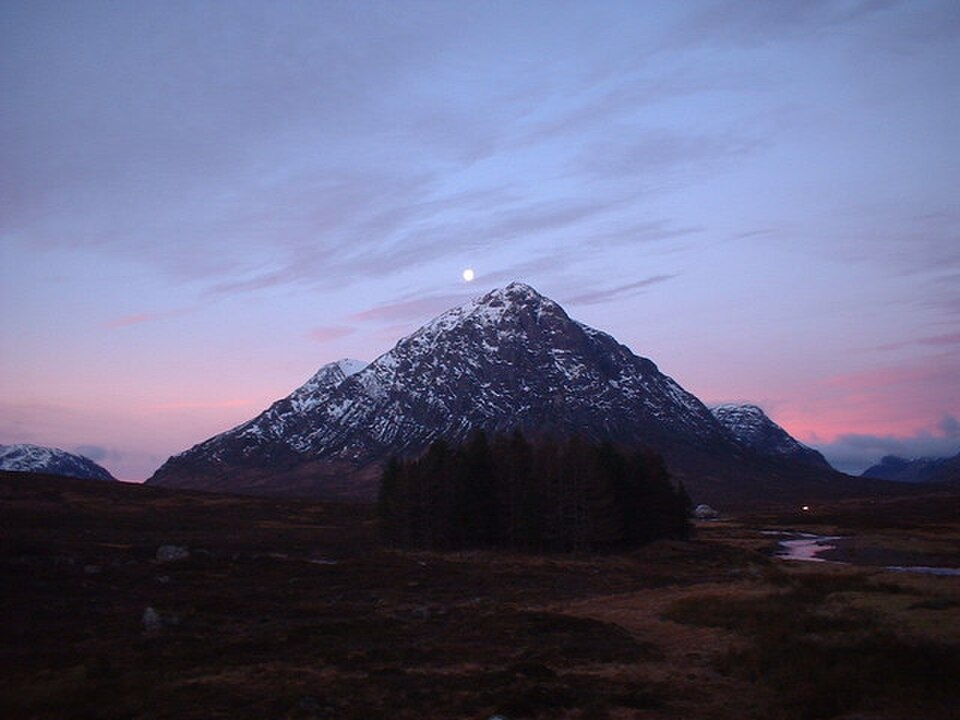
cc Dave Miller, Moon over Buchaille Etive Mor, https://commons.wikimedia.org/wiki/File:Moon_over_Buchaille_Etive_Mor_-_geograph.org.uk_-_365838.jpg
I’d been following the comments here on my blog during the trip, without having the time or ability to comment myself from my phone, but I watched the debate about collapse and how to prepare for it under this post unfold with interest. Thanks as always to commenters for finding the time to contribute. One comment that landed with me was this from Joe Clarkson:
Electricity and the devices using it won’t ever be anything other than part of a transitional period between industrialism and an almost entirely post-industrial future.
I think that will probably turn out to be right, but meanwhile it’s impossible to say these kind of things on mainstream platforms and be taken seriously. I discovered recently that someone I’ve interacted with online about collapse issues is using a pseudonym because of the blowback associated with taking such positions – a small litmus test, perhaps, of quite how deep our present state of denial is. Some people I know who are switched on to all this advocate for just getting on with the practical process of learning low-input livelihood skills. There’s a lot to be said for that, but I’m not convinced that personal skill prepping will save too many arses. For that, we’d need more generalised cooperative action – hence the need to communicate the gravity of the situation. And so back to square one.
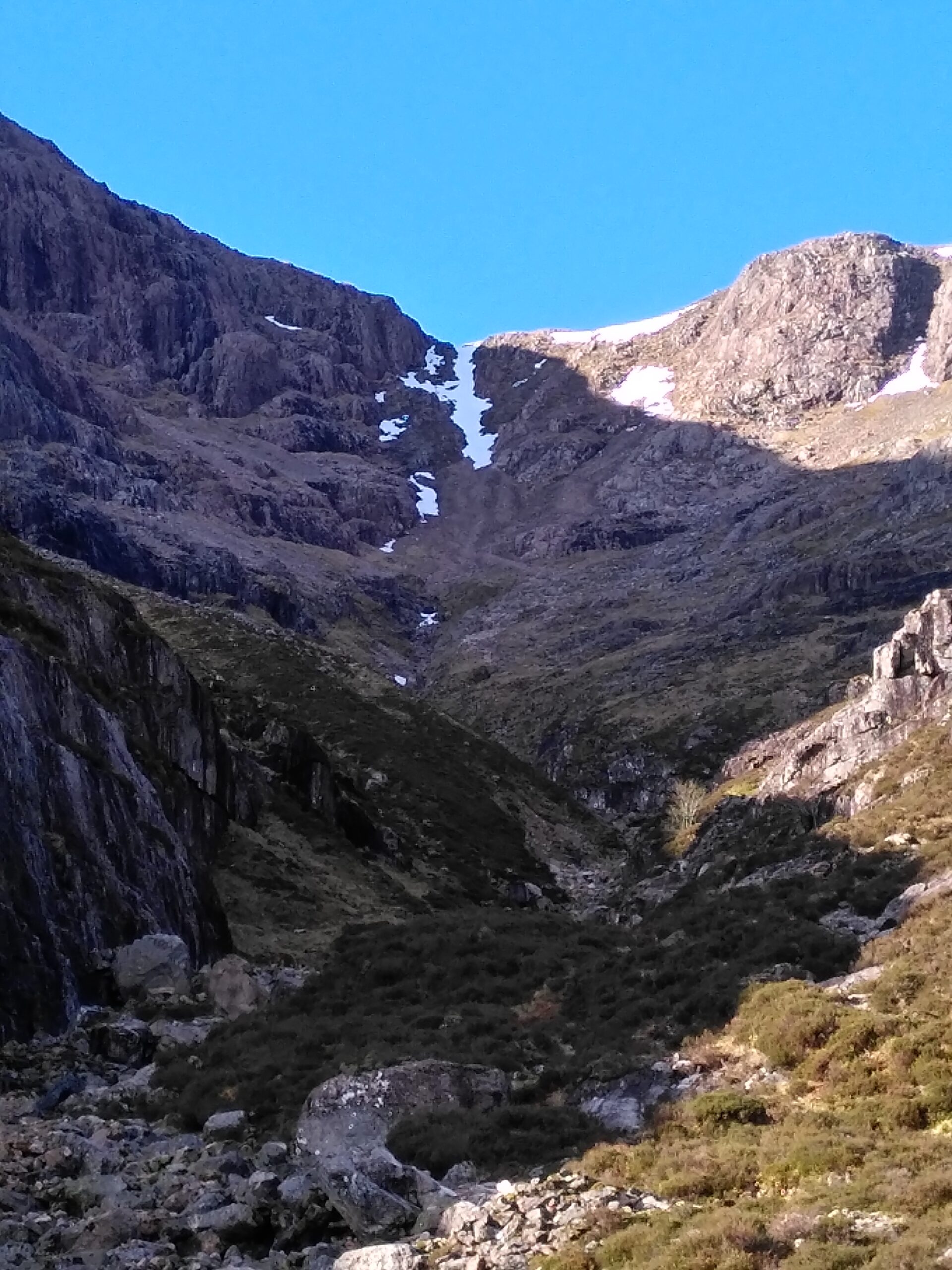
Such were my thoughts as I began the hike up the Buchaille. Before I got too far I noticed the large tongue of snow you can see in the next picture guarding the summit ridge. In full winter conditions, that area is an avalanche blackspot, which sadly has claimed several lives. But I hadn’t been expecting so much snow to linger into May, and I only had my summer hiking gear with me. As southern England now swelters in >30C heat, smashing previous May records by fully 2C, it’s hard to believe I was among the snows in Scotland barely more than a week ago, but there we are. Late snows and early sunshine – you’d think current weather patterns might suggest worrisome climate change. But apparently not, judging from the news cycle.
Anyway, as long-term readers of this blog will know, I’m a sucker for an over-extended metaphor, so I decided to play a little game. If I soldiered gamely on into the death zone ahead and made it to the summit, I told myself, then I’d take that as evidence humanity would see its way through present difficulties and bottlenecks, avoiding collapse. (In truth, there was no chance of a dangerous avalanche, but I’m not the sort to let the truth get in the way of a good metaphor. And I genuinely didn’t know if I’d be able to make it through the snow to the ridge). Ecomodernists 1, Collapsologists 0. If I beat a retreat from the danger zone back the way I came, I’d take it as evidence of a low-energy retreat to agrarian localism. Neo-agrarians 1, Eco-modernists 0. And if I died or otherwise collapsed en route … well, Collapsologists 1, Everyone else 0.
As I got higher, I saw that the obvious route followed a path terminating in a much shorter section of steep snow to the right of the main snow tongue, so I followed that. *The few other hikers around seemed to me overly anxious to avoid any contact with the snow and were trying to pioneer their own routes to the summit ridge, which looked more dangerous and less promising to me than embracing the snowy bottleneck. I pressed on, somewhat regretting that my ice axe, crampons and winter climbing boots were far away at home in Somerset where they’re unlikely to ever be much use – except perhaps in the event of an AMOC shutdown, and … er … probably not even then.
In the event, a few yards of rather precarious tiptoeing on the steep snow in my bendy summer hiking shoes, using a trekking pole in lieu of an ice axe, saw me to the summit ridge. *Victory to the ecomodernists!
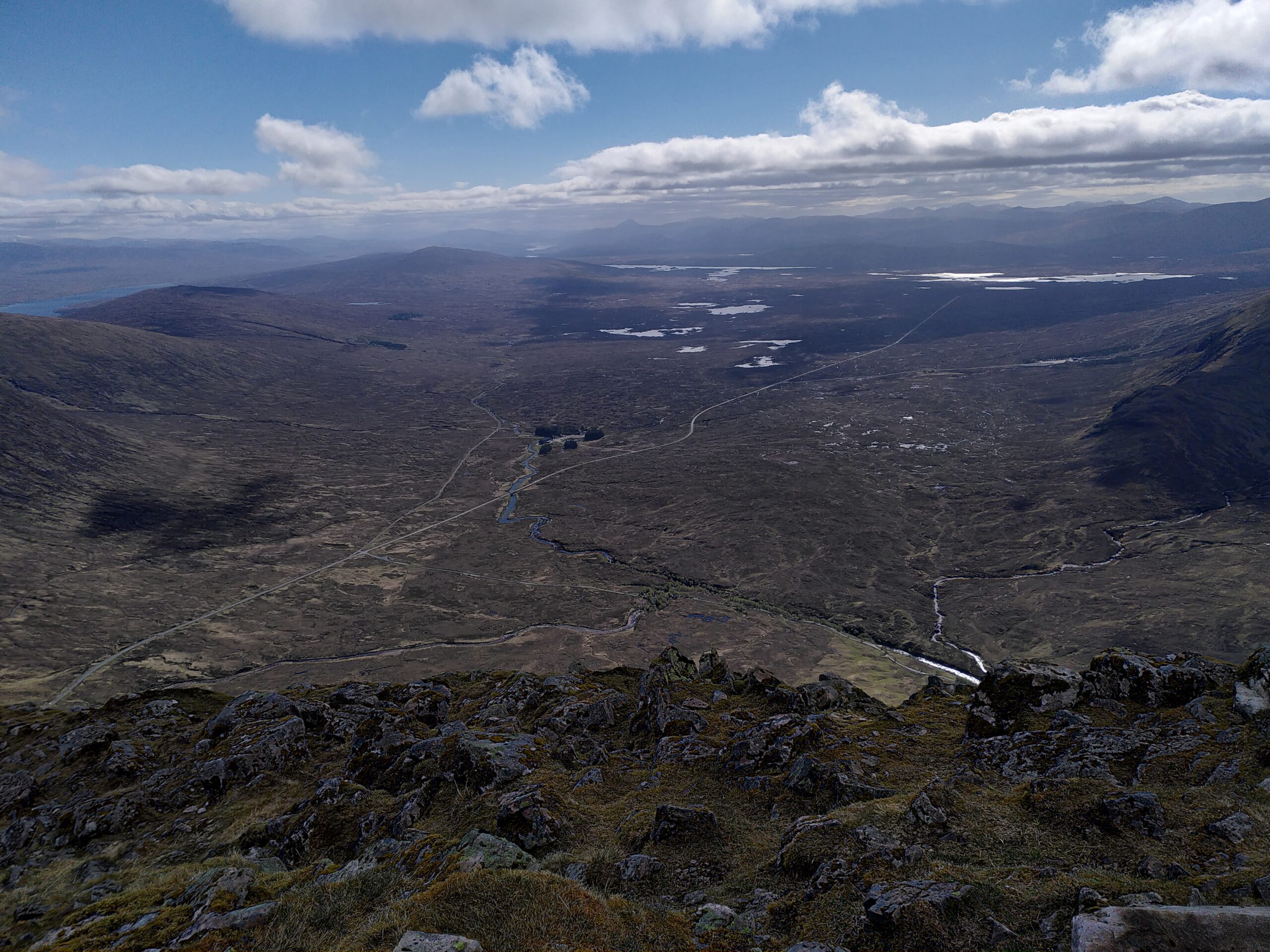
*Now, I’ve got to tell you, the view from up there was magnificent – well worth aiming for! Here’s a picture looking down from the main summit, Stob Dearg, onto Rannoch Moor, one of the many places in Scotland where Britain’s last wolf is rumoured to have been killed. The poor-quality camera on my phone doesn’t do it justice, but anyway. At least you can see in the photo the long, straight gash of the A82 trunk road scribed into the moor. *The benefits of progress, eh?
*Well, the view was great, but it was pretty inhospitable up on the summits all the same, with cold, knifing winds and sub-freezing temperatures. To make matters worse, when I got to the top of the next summit on the ridge, Stob na Doire, I discovered that I’d forgotten to pack my food for the day. *So not only was it pretty cold up there, it was also pretty famishing. But I had another summit to go, and I pressed on regardless, cold and hungry, to Stob na Broige before making my way back down to the road. *There was a very obvious route down in the form of a large path, albeit requiring a bit more precarious snow teetering at the top, but just when it seemed the path would lead all the way to the flat safety of the moor it petered out into a mazy cliff that I had to pick my way down through with care. Eventually, though, I reached the moor where the sun burned so hot that lizards were basking on the footpath. *From subzero summits to basking lizards – it’s surprising how narrow the temperature band for human comfort is. After seven hours hiking on an empty stomach, I was back to civilization.
Six brief thoughts to close:
First, tf wrote here a while ago,
Here in Scotland, between renewables, rewilding and carbon offsetting, land has become unaffordable not just for the ‘poor’ but even for the moderately affluent home owning Scots (the proliferation of English regional accents in the Highlands is a symptom of this, the buying power in the UK being greater the further south one lives).
This is certainly true – maybe not only because of renewables, rewilding and carbon offsetting, although they definitely play their part. But even a lot of the Scottish accents you hear are from people not raised locally in the Highlands, and a lot of the jobs that exist service fly-by-night tourists like me. Meanwhile, despite the good efforts to preserve the Gaelic language, it’s ghostly presence in place names like the ones I’ve mentioned above perhaps tell a tale about the march of de-localisation. I’m interested in hearing thoughts about what an agrarian local livelihood economy might look like in the Highlands. I agree on the need for land reform, but what comes after interests me. The crofting and the deer are something to work with at least!
Second, supposing Joe’s right about the future of electricity, I’m interested in thoughts about what path that might take – and also what might future people think about the present electric age, if they’re aware of it at all.
Third, while I was away I was reading about Tasmanian aborigines (long story…) The idea has got around that they lost the ability to make fire, and took to carrying cinders around with them that they had to ensure didn’t go out. The evidence for this seems almost non-existent – it’s based on a single remark by an aborigine recorded by a European colonist that if his cinder went out while he was travelling he’d ask for a light from another aborigine. This resonated with me, partly because I’d forgotten to bring a lighter for my camping stove while I was in the mountains and had to ask for a light from someone else. We’re quick to scorn the skills of other cultures, while trumpeting our technological triumphs. Putting astronauts on the moon is a much trumpeted one. But most of ‘us’ didn’t put astronauts on the moon, while at the same time most of us individually don’t have the first clue about how to do simple things like start a fire. How do we weigh the skills of a culture and the skills of its constituent individual people?
Fourth, I made a point on this trip of climbing only Munros – Scottish peaks that attain the all-important height of 914.4 metres (that’s 3,000 feet in old money). Completing all of them (there are 282) is a game that some like to play, but it often invites derision for its tick-box approach. Still, as Steve Kew says in the guidebook I was using “Some people may deride those who are working through the Munros, as if the act of ticking them off a list somehow corrupts an otherwise pure experience of mountaineering. In my experience the opposite is true. By accepting the challenge of doing them all you open yourself up to a host of new experiences, and you find yourself in a variety of mountain situations that you might never have otherwise experienced”. Great point – and only 255 to go in my case! The issue made me ponder how various initiation rituals and spirit quests among ancestral cultures are itemised and structured. Mere tick-list, or routinisation as a method for attaining transcendence?
Fifth, if you happen to be on Ben Wyvis using the aforementioned guidebook by Steve Kew and you follow his advice of traversing the mountain via Tom a’ Chòinnich and thence what he calls ‘a gentle walk down’ to the Allt a’ Gharbh Bhaid which you ‘follow through the trees’, bear in mind that what this actually involves is a very long walk through pathless bog, involving multiple potentially quite wet river crossings and tumbles into hidden trenches. *If you’re prepared for the difficulties ahead, it’s actually a delightful bit of mild adventuring, whereas if you’re led by the guidebook into thinking it’s a gentle walk, it’s remarkably irksome. *If you’d prefer an easy time of it, retrace your steps from the highest summit that you’ve reached.
And finally, sixth – well the ecomodernists won my wager with myself. But I don’t think they’re going to win their real-world wager. *And, clearly, the world they’re trying to bring in to being will involve mass hunger.
* For those unfamiliar with my tendency to torture a metaphor, I’ve indicated where I’m doing it with this handy asterisk system.
Peter Bellwood First Farmers: The Origins of Agricultural Societies
Tim Flannery The Future Eaters
David Horton The Pure State of Nature
Lyndall Ryan Tasmanian Aborigines: A History Since 1803
Peter Sutton and Keryn Walshe Farmers or Hunter-Gatherers? The Dark Emu Debate

If you like my writing, please help me keep the blog going by donating!
 Subscribe via RSS
I haven’t spent enough time in the Scottish Highlands to have clear ideas about what a truly local livelihood might look like there, but your observation about the different microclimates at different altitudes reminds me of Andean and Quechua patterns of farming, with different crops at different altitudes. Of course I know even less about that… Perhaps the freeze dried potato is not so out of place in the Scottish Highlands as it would be in East London, though.
Meanwhile, I agree that individual skills prepping can only go so far. Sure, I know a bunch of different ways of making fire without matches or lighter, sure, I can make string from nettles or grow potatoes or whatever… and as electricity and fossil energy become more scarce, those kinds of skills will become more important to households and communities. But how we cooperate at household and local community level is more important right now than whether a given community has someone who can keep the solar panels limping along for another decade; and the “soft” skills around communication, cooperation, good governance and so on are ones we can practice now — and need to revive now, really — without needing to predict the exact nature of future challenges.