
Author of Finding Lights in a Dark Age, Saying NO to a Farm-Free Future and A Small Farm Future
Menu
Posted on May 27, 2026 | 30 Comments
Sorry I’ve been so silent here of late. I’ve got a lot of work on various fronts, some of which I may mention here soon, which is keeping me from blogging. But if there’s a Small Farm Future/Dark Age Light hole in your life, do listen in to this Crazy Town podcast I did with Jason Bradford, which was quite a fun conversation.
Despite my busy-ness I must confess that I did take a brief holiday in the Scottish Highlands – partly to visit my son who lives there and partly to hike in the mountains, which is something I like to do to clear my head when the world around me seems too crazy. I’ve been feeling the pull of the mountains a lot lately.
In my younger days, I was quite into rock-climbing and mountaineering, whereas I tend to go for gentler hikes these days. A lot of people in the climbing scene are quite alienated from mainstream narratives about progress, safety, comfort and the joys of modern civilization, although ultimately the sport is entirely a product of it. Eventually, the idea of staying in one spot and properly trying to produce food and livelihood from it, rather than adventuring off in the mountains with packaged food and high-tech climbing gear arising from that which I wished to escape seemed to me the better option. Not that I’ve been brilliant at either.
Anyway, a few brief learnings here from my Highlands diversion. First, I made an amazing trip with my son to Chanonry Point, a narrows in the sea inlet of the Moray Firth where several Highland rivers drain. The salmon running through it on the rising tide attract dolphins, who create quite a spectacle for the human watchers on the beach, as they speed through the water in pursuit of the fish. There are some fishing folk who blame the struggles of the salmon on the dolphins. Nah, it’s us. Still, if you take the various interest groups in the Highlands, and elsewhere in the country – fisherfolk, conservationists, farmers, landowners, nature loving or right-to-roaming members of the public and the architects of business-as-usual growth economics – while all have their blind spots, I’d say it’s mostly the latter who are really screwing things up.
Later that day I visited a sheep farm. Lambing was in full swing, a month later than on our holding. Despite our human conceits, latitude and altitude get the final say. There’s quite a difference between a farm with nine hundred breeding ewes and the situation on our smallholding, with its grand total of three. More chilled out on the latter for sure, but possibly a bit too much – the hustle and organisation required on commercial scales is always interesting to see.
After that, I devoted myself to hiking up a few mountains – including Buchaille Etive Mor, ‘The Great Herdsman of Etive’, one of Scotland’s most iconic peaks, which had long been on my to do list.
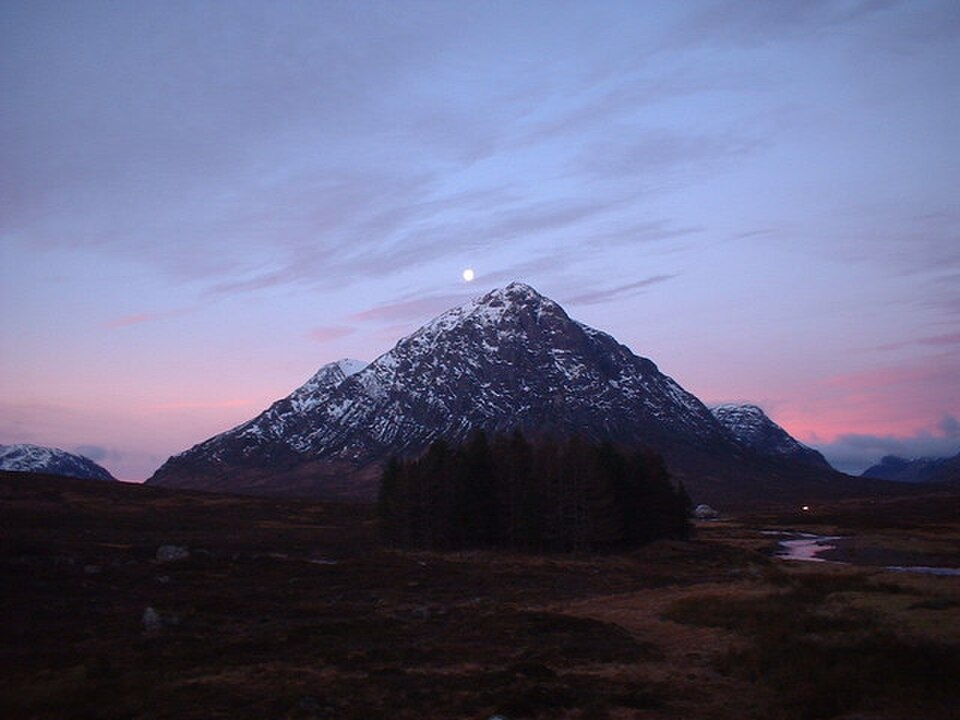
cc Dave Miller, Moon over Buchaille Etive Mor, https://commons.wikimedia.org/wiki/File:Moon_over_Buchaille_Etive_Mor_-_geograph.org.uk_-_365838.jpg
I’d been following the comments here on my blog during the trip, without having the time or ability to comment myself from my phone, but I watched the debate about collapse and how to prepare for it under this post unfold with interest. Thanks as always to commenters for finding the time to contribute. One comment that landed with me was this from Joe Clarkson:
Electricity and the devices using it won’t ever be anything other than part of a transitional period between industrialism and an almost entirely post-industrial future.
I think that will probably turn out to be right, but meanwhile it’s impossible to say these kind of things on mainstream platforms and be taken seriously. I discovered recently that someone I’ve interacted with online about collapse issues is using a pseudonym because of the blowback associated with taking such positions – a small litmus test, perhaps, of quite how deep our present state of denial is. Some people I know who are switched on to all this advocate for just getting on with the practical process of learning low-input livelihood skills. There’s a lot to be said for that, but I’m not convinced that personal skill prepping will save too many arses. For that, we’d need more generalised cooperative action – hence the need to communicate the gravity of the situation. And so back to square one.
Such were my thoughts as I began the hike up the Buchaille. Before I got too far I noticed the large tongue of snow you can see in the next picture guarding the summit ridge. In full winter conditions, that area is an avalanche blackspot, which sadly has claimed several lives. But I hadn’t been expecting so much snow to linger into May, and I only had my summer hiking gear with me. As southern England now swelters in >30C heat, smashing previous May records by fully 2C, it’s hard to believe I was among the snows in Scotland barely more than a week ago, but there we are. Late snows and early sunshine – you’d think current weather patterns might suggest worrisome climate change. But apparently not, judging from the news cycle.
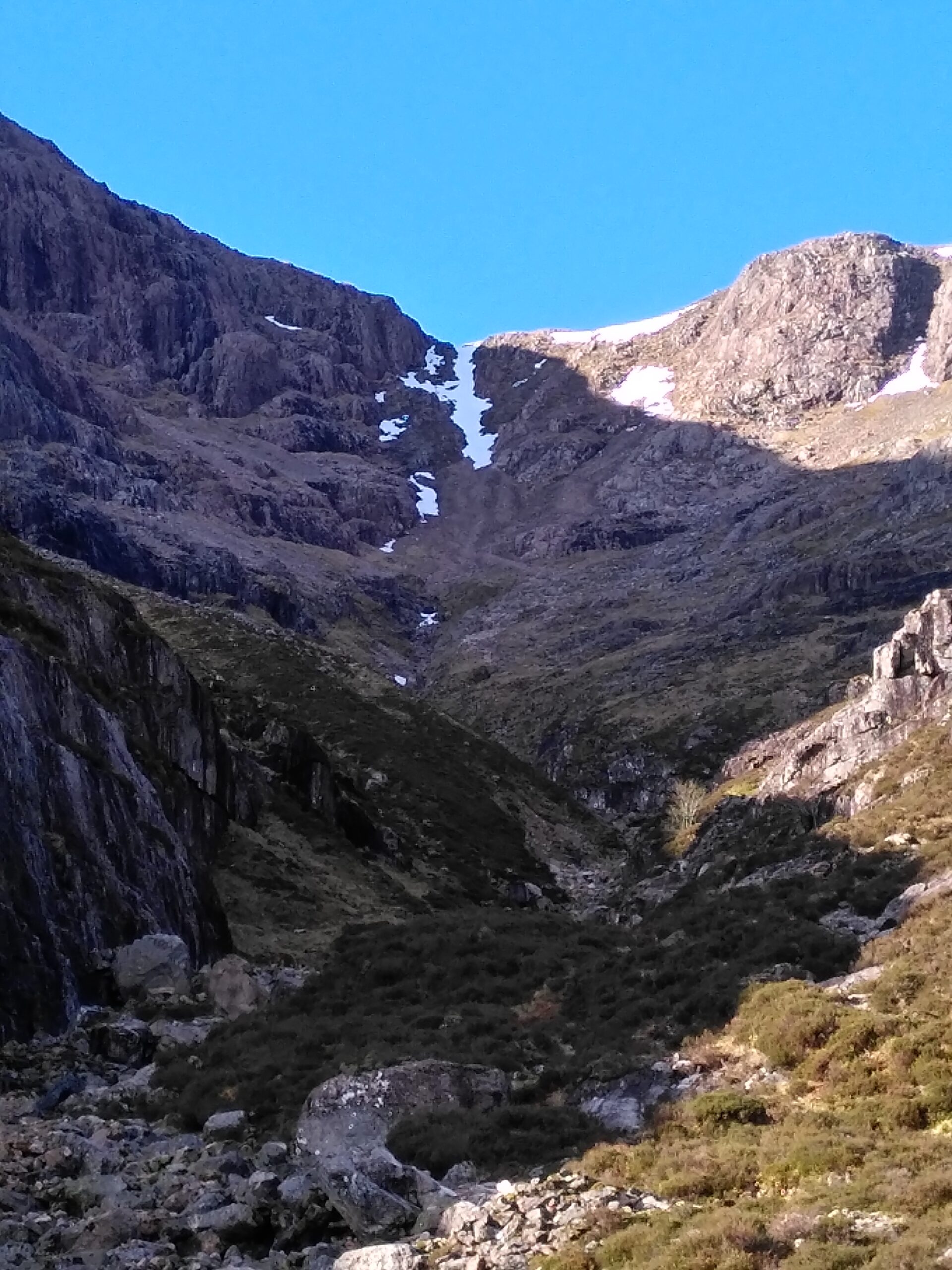
Anyway, as long-term readers of this blog will know, I’m a sucker for an over-extended metaphor, so I decided to play a little game. If I soldiered gamely on into the death zone ahead and made it to the summit, I told myself, then I’d take that as evidence humanity would see its way through present difficulties and bottlenecks, avoiding collapse. (In truth, there was no chance of a dangerous avalanche, but I’m not the sort to let the truth get in the way of a good metaphor. And I genuinely didn’t know if I’d be able to make it through the snow to the ridge). Ecomodernists 1, Collapsologists 0. If I beat a retreat from the danger zone back the way I came, I’d take it as evidence of a low-energy retreat to agrarian localism. Neo-agrarians 1, Eco-modernists 0. And if I died or otherwise collapsed en route … well, Collapsologists 1, Everyone else 0.
As I got higher, I saw that the obvious route followed a path terminating in a much shorter section of steep snow to the right of the main snow tongue, so I followed that. *The few other hikers around seemed to me overly anxious to avoid any contact with the snow and were trying to pioneer their own routes to the summit ridge, which looked more dangerous and less promising to me than embracing the snowy bottleneck. I pressed on, somewhat regretting that my ice axe, crampons and winter climbing boots were far away at home in Somerset where they’re unlikely to ever be much use – except perhaps in the event of an AMOC shutdown, and … er … probably not even then.
In the event, a few yards of rather precarious tiptoeing on the steep snow in my bendy summer hiking shoes, using a trekking pole in lieu of an ice axe, saw me to the summit ridge. *Victory to the ecomodernists!
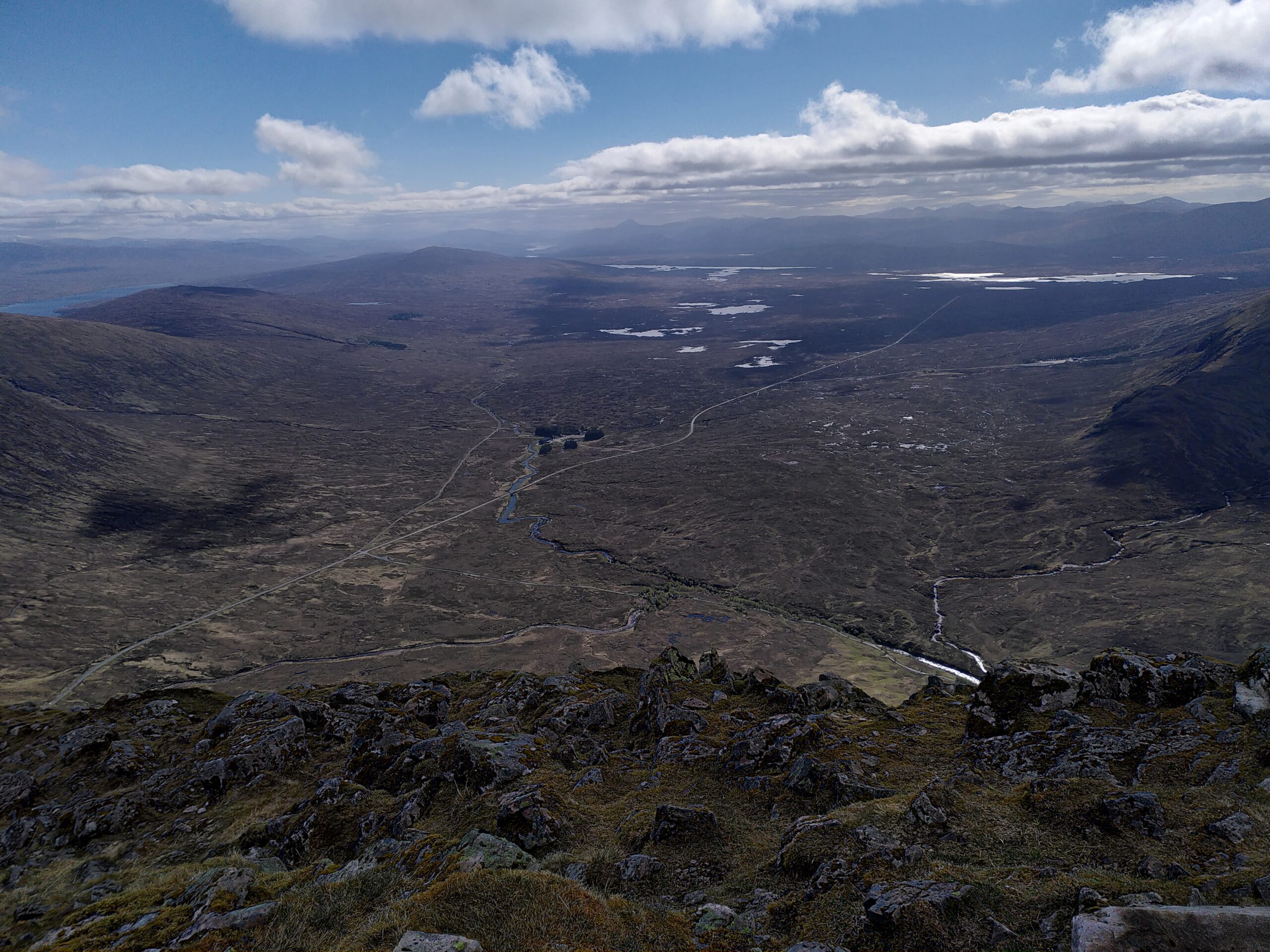
*Now, I’ve got to tell you, the view from up there was magnificent – well worth aiming for! Here’s a picture looking down from the main summit, Stob Dearg, onto Rannoch Moor, one of the many places in Scotland where Britain’s last wolf is rumoured to have been killed. The poor-quality camera on my phone doesn’t do it justice, but anyway. At least you can see in the photo the long, straight gash of the A82 trunk road scribed into the moor. *The benefits of progress, eh?
*Well, the view was great, but it was pretty inhospitable up on the summits all the same, with cold, knifing winds and sub-freezing temperatures. To make matters worse, when I got to the top of the next summit on the ridge, Stob na Doire, I discovered that I’d forgotten to pack my food for the day. *So not only was it pretty cold up there, it was also pretty famishing. But I had another summit to go, and I pressed on regardless, cold and hungry, to Stob na Broige before making my way back down to the road. *There was a very obvious route down in the form of a large path, albeit requiring a bit more precarious snow teetering at the top, but just when it seemed the path would lead all the way to the flat safety of the moor it petered out into a mazy cliff that I had to pick my way down through with care. Eventually, though, I reached the moor where the sun burned so hot that lizards were basking on the footpath. *From subzero summits to basking lizards – it’s surprising how narrow the temperature band for human comfort is. After seven hours hiking on an empty stomach, I was back to civilization.
Six brief thoughts to close:
First, tf wrote here a while ago,
Here in Scotland, between renewables, rewilding and carbon offsetting, land has become unaffordable not just for the ‘poor’ but even for the moderately affluent home owning Scots (the proliferation of English regional accents in the Highlands is a symptom of this, the buying power in the UK being greater the further south one lives).
This is certainly true – maybe not only because of renewables, rewilding and carbon offsetting, although they definitely play their part. But even a lot of the Scottish accents you hear are from people not raised locally in the Highlands, and a lot of the jobs that exist service fly-by-night tourists like me. Meanwhile, despite the good efforts to preserve the Gaelic language, it’s ghostly presence in place names like the ones I’ve mentioned above perhaps tell a tale about the march of de-localisation. I’m interested in hearing thoughts about what an agrarian local livelihood economy might look like in the Highlands. I agree on the need for land reform, but what comes after interests me. The crofting and the deer are something to work with at least!
Second, supposing Joe’s right about the future of electricity, I’m interested in thoughts about what path that might take – and also what might future people think about the present electric age, if they’re aware of it at all.
Third, while I was away I was reading about Tasmanian aborigines (long story…) The idea has got around that they lost the ability to make fire, and took to carrying cinders around with them that they had to ensure didn’t go out. The evidence for this seems almost non-existent – it’s based on a single remark by an aborigine recorded by a European colonist that if his cinder went out while he was travelling he’d ask for a light from another aborigine. This resonated with me, partly because I’d forgotten to bring a lighter for my camping stove while I was in the mountains and had to ask for a light from someone else. We’re quick to scorn the skills of other cultures, while trumpeting our technological triumphs. Putting astronauts on the moon is a much trumpeted one. But most of ‘us’ didn’t put astronauts on the moon, while at the same time most of us individually don’t have the first clue about how to do simple things like start a fire. How do we weigh the skills of a culture and the skills of its constituent individual people?
Fourth, I made a point on this trip of climbing only Munros – Scottish peaks that attain the all-important height of 914.4 metres (that’s 3,000 feet in old money). Completing all of them (there are 282) is a game that some like to play, but it often invites derision for its tick-box approach. Still, as Steve Kew says in the guidebook I was using “Some people may deride those who are working through the Munros, as if the act of ticking them off a list somehow corrupts an otherwise pure experience of mountaineering. In my experience the opposite is true. By accepting the challenge of doing them all you open yourself up to a host of new experiences, and you find yourself in a variety of mountain situations that you might never have otherwise experienced”. Great point – and only 255 to go in my case! The issue made me ponder how various initiation rituals and spirit quests among ancestral cultures are itemised and structured. Mere tick-list, or routinisation as a method for attaining transcendence?
Fifth, if you happen to be on Ben Wyvis using the aforementioned guidebook by Steve Kew and you follow his advice of traversing the mountain via Tom a’ Chòinnich and thence what he calls ‘a gentle walk down’ to the Allt a’ Gharbh Bhaid which you ‘follow through the trees’, bear in mind that what this actually involves is a very long walk through pathless bog, involving multiple potentially quite wet river crossings and tumbles into hidden trenches. *If you’re prepared for the difficulties ahead, it’s actually a delightful bit of mild adventuring, whereas if you’re led by the guidebook into thinking it’s a gentle walk, it’s remarkably irksome. *If you’d prefer an easy time of it, retrace your steps from the highest summit that you’ve reached.
And finally, sixth – well the ecomodernists won my wager with myself. But I don’t think they’re going to win their real-world wager. *And, clearly, the world they’re trying to bring in to being will involve mass hunger.
* For those unfamiliar with my tendency to torture a metaphor, I’ve indicated where I’m doing it with this handy asterisk system.
Peter Bellwood First Farmers: The Origins of Agricultural Societies
Tim Flannery The Future Eaters
David Horton The Pure State of Nature
Lyndall Ryan Tasmanian Aborigines: A History Since 1803
Peter Sutton and Keryn Walshe Farmers or Hunter-Gatherers? The Dark Emu Debate

If you like my writing, please help me keep the blog going by donating!
 Subscribe via RSS
I haven’t spent enough time in the Scottish Highlands to have clear ideas about what a truly local livelihood might look like there, but your observation about the different microclimates at different altitudes reminds me of Andean and Quechua patterns of farming, with different crops at different altitudes. Of course I know even less about that… Perhaps the freeze dried potato is not so out of place in the Scottish Highlands as it would be in East London, though.
Meanwhile, I agree that individual skills prepping can only go so far. Sure, I know a bunch of different ways of making fire without matches or lighter, sure, I can make string from nettles or grow potatoes or whatever… and as electricity and fossil energy become more scarce, those kinds of skills will become more important to households and communities. But how we cooperate at household and local community level is more important right now than whether a given community has someone who can keep the solar panels limping along for another decade; and the “soft” skills around communication, cooperation, good governance and so on are ones we can practice now — and need to revive now, really — without needing to predict the exact nature of future challenges.
Thanks Chris.
Sounds like a fun trip. Yes, as Kathryn mentions, I often think about the daily skills that are absolutely necessary for de-industrial living, but which are difficult to master (and propagate) while simple butane lighters (for example) are ubiquitous.
But – as far as fire-making goes, even empty butane lighters are valuable for their spark-makers. There will be salvage for centuries, unless we are incredibly careless.
I’m not entirely convinced that electricity will go away completely. Modern transistors and all our digital electronics, yes. That includes silicon photovoltaic panels too. But a well made copper-wound generator could be maintained for many years by skilled blacksmiths. Lead-acid batteries too, if you are willing to deal with the toxic materials. There are many stories of farmer/tinkerers making their own home power stations in the early 1900s. It wouldn’t be easy, and would be very small scale, but such is possible with wood burning technology.
An interesting thought though: why would anyone bother? Those farm/home power systems were mostly made for electric light, and radio receivers. I can’t see anybody making their own light bulbs or vacuum tubes without a serious tech lab. So future electricity would probably rely on some centralized industrial plant, with all the attendant energy and organizational issues.
Related – in a round about way – is your thought about box-checking vs. transcendence. It seems to me, that it doesn’t matter what your motivation is, just so long as you go out and do the activity that brings you to the transcendent.
For me, that was surf. I know people who would travel the world for the ultimate wave. I didn’t see that they transcended more than those of us who lived near a beach and mostly stayed home. The aspirational travel was mostly an expression of enthusiasm. And said travel will become less possible in future.
So also, surfing becomes less possible with advanced age. Mountaineering too, eh?
Currently I meet those needs by dancing. Which only requires a relatively small group of like-minded friends. Bringing us back to ‘the “soft” skills’ that Kathryn mentions.
Re. Electricity Most people don’t think of electricity as a way to power farm equipment but I use it as a way to transition from fossil fuels to a lower energy helping hand. Because battery electric power in the tools I use is very limited it means I need to adapt manual tools I already use to make their use slightly more productive. ( an electric wheelhoe is used exactly like a manual one ) This is very different than trying to replace the massive power of fuels and ICE engines with an electrical replacement. So if electrics are just a step up from manual methods the step back down is easier because the techniques used in manual cultivation of crops and the tools used are much closer than switching from a 500 horsepower tractor back to a grub hoe. So even if electrics suddenly disappear ( not likely for solar battery electrics in one lifetime ) the tools and techniques to feed yourself are already standard operating procedure. Solar panels and batteries already have decadal timeframes of utility, so if they are going away it isn’t going to happen in one typical farmers career. You can also buy replacements now to store away for future equipment failures , so their utility can be expanded for a long time after all manufacture had stopped.
Just to springboard off this one, I have recently discovered the two-wheeled (walk behind) tractors that appear to be popular in other parts of the world.
While they are nothing in comparison to modern mega-tractors, it does appear that they are capable of a lot of work without as much compaction or cost. One video I saw compared it to a good oxen team.
I wonder if there is any real possibility of having one of those as an electric tool, with medium size batteries that would allow at least few hours of work, or be swappable. Combined with a moderate solar system that might be a decent middle ground.
There is a walk behind tiller called the “ Barreto “ that could easily be converted to battery electric but you kinda miss my point. Utilizing lots of horsepower , even electric power, does not easily walk back to manual techniques . I am making the argument that electrics can serve as a stepping stone down the technology stepladder but I kinda agree with the notion that fossil fuel tools or electrics are both unlikely to be supported once the fossil fuels run out. For many many millions of people I think it’s important to explore how to farm without fuel before TSHTF.
I really love my electric secateurs, but using them isn’t substantially different than using manual ones, except that I can get quite a bit more done before my joints start to complain. There’s a much more substantial difference between, say, a scythe and an electric lawnmower.
A scythe is kinda useless without technique and tools to peen the blade, if European, or to have the proper stone to get the angle right on an American one. Using a scythe takes some skill, some knowledge about how to maintain the blade, and how to adjust handles and ultimately how to swing it.
That said I use an electric weed trimmer because it doesn’t really take any skill. It doesn’t cut wheat worth a hoot however so I have a scythe and I am trying to learn how to use it. I hand sickle is a step down from a scythe and a sickle and a quern are where we are headed again . It is as far down the technology ladder as we can get and hope to feed ourselves without fuels.
Zero steel needed.
“I’m not convinced that personal skill prepping will save too many arses. For that, we’d need more generalised cooperative action ”
Obviously both would be preferable. personal skills can be acquired as soon as you resolve to start working on them, and don’t require any group cooperation, but generalized cooperative action can be great way to share and more quickly acquire those same personal skills from human to human interaction.
(I’d read about bow drill fire starting for years, but never got past the smolder stage. Took a class with a nearby instructor, and got it figured out).
Forgot the food AND the lighter? 🙂
We used to camp so often, we did not use a packing list, but found that after we slowed down, and trips were less common, we would set off without a checklist at our peril.
In a no grid future you have to ask yourself “is it worth it to generate my own ” , time working to feed yourself is far more important than electric light . Every farm job was once done without electricity or diesel , it could be done again it will need a hell of a lot more people involved . Cheap plentiful energy replaced people and animals , no cheap energy reverses that .
My impression is that farmers did adopt kerosene lamps as soon as they were readily available, because they were safer and more reliable than candles…
At this end of the year, getting up with the sun and going to bed when it gets dark still leaves me sleep deprived. But in December, I sure find my small headlamp — which I can charge with a small portable solar panel (even in December!) — comes in handy when the work to be done outside exceeds the hours of daylight.
I work with candles at church. I would not like to rely on them for lighting on a regular basis, especially in stressful situations like dealing with a sick child or trying to repair a water filtration system.
It’s also true that I personally cannot create a lightbulb from scratch, or a lithium battery for that matter. But in my own personal prepping, “access to decent lighting that I can still charge if the electricity grid is down” is one of the things I prioritise to the point of multiple redundancy, and there are good reasons for that.
On a societal level, I think health tools like tetanus vaccines, access to safe drinking water, and hygiene procedures before assisting with childbirth are probably more important than lighting. But those will all also be a lot easier to keep going if we can see what we’re doing, and I can imagine someone who is good at salvaging LEDs and batteries from scrapyards and making them work again being a very valuable member of any community.
I listened to a podcast I wish I could find again , the jist is , the new England whaling fleet disappeared in two years after kerosene became available replacing whale oil for lighting , over 150 ships either sold ,, broken up or just abandoned , towns died , shipyards closed and the people left .
All in two years , protests did not save the whale, kerosene did .
“Far from saving the whales, it was oil that nearly obliterated them, and may yet still do so.”
–Chris Smaje
Why oil didn’t save the whales – and why it matters
Posted on June 27, 2020
https://chrissmaje.com/2020/06/why-oil-didnt-save-the-whales-and-why-it-matters/
Yep whale oil nearly obliterated them , in our local museum ( it ain’t much of a museum considering the town was founded in 1880 ) there is a shop , on the shelves are gallon cans of ” pure smoke free whale oil ” 90. Cents a can . Gallon Kerosene cans were .5 cent a gallon , the cans date from somewhere around 1900 .
Can’t see anyone trying to start up a whaling business , doubt if you could find enough crew members crazy enough to do that .
*As another aging mountaineer, my aspirations have been getting less lofty, and my focus on accumulation of summits climbed (with the travel required for this) has been replaced with a recognition of the rich experiences, challenges, and deep learnings possible in the local hills where I go daily.
*My expenditures on climbing gear are now minimal to nonexistant, as I mainly “make do” with what is already available. *I’m thinking more about who could use my existing gear when I have no need for it.
Metaphors aside, I would love to live in Scotland with some Munros nearby.
Thanks for the comments. I feel truly blessed to have sharp-eyed commenters who can join the dots of that which I leave implicit in my posts to bring out my full haplessness and incompetence 🙂
Anyway, in brief:
– I’ve not got beyond the smoulder stage with bow drills – something to work on. Then again, a bow drill isn’t exactly trivial to manufacture from scratch on a camping trip. It makes you think how complex even pretty basic tech can be. If I forgot the lighter, I’d probably have forgotten the bow drill too. Mind you, I’d have loved to be lighting my stove with a bow drill in one fancy campsite I stayed in, full of sleek caravans and campervans. Would have turned some heads.
– as to personal skills vs community co-operation, yes of course to both. But the latter is really critical. I agree with Kathryn about practicing soft skills around cooperation and governance now, although one of the problems is that existing structures don’t really allow us to focus on the kind of cooperations that we need to figure out
– thanks for the electricity discussion – a lot of interesting points. I’m wondering how the retreat from electricity may pan out. Certainly a relatively long-term thing, barring catastrophic events. I guess more remote and rural areas would lose it first. A mixed blessing perhaps.
– on scythes, mowers etc, well don’t forget the renowned Vallis Veg mowing trial: https://chrissmaje.com/2015/07/of-agricultural-efficiency-the-vallis-veg-mowing-trial/. There’s a whole range of interesting issues wrapped up here about skills and competence. I’m not a massively skilled scythesman, but I can use one to some effect. I also know how to drive a tractor and mower, and how to maintain them up to a basic level, but keeping them going long-term without access to readymade parts and skilled backup would be a different matter. The gradations of competence in all this and at what level we can make do are interesting.
– re Eric’s point on the matter of transcendent ritual, I think our society has individualised this into a range of personalised quests, albeit ones with an element of collective subculture like climbing the Munros. In that context, maybe it’s true that people’s big challenges achieve no more transcendence than everyday ones. It might be different if they were more collectively recognised. On the other hand, I’m not that big personally on shared collective experience – hiking on my own in the mountains suits me pretty well, generally. So it’s complicated I guess, like most things
– great metaphor-mongering, Steve L. The Scottish mountains are great, though surely there are some fine ones in your neck of the woods too? British mountains don’t impress much in terms of altitude, though they do all start pretty much at sea level, which people sometimes forget.
– on the oil saved the whales narrative, yeah it’s a bit of a misconception, as outlined in some of my previous posts. There’s possibly some evidence that the advent of kerosene temporarily reduced the US sperm whale catch, but the problem is that the advent of diesel (and the invention of new products like margarine) then massively increased the global whale catch to the point of extinction in many cases. Given the reproductive style of the animals, some of them have barely recovered despite years of whaling bans. Another reason why starting commercial whaling now wouldn’t make sense. Reading about the historic hunting of bowheads in the Arctic where only the baleen was kept and the rest of the carcass was discarded makes me weep
– fun fact about whales, their sunken bones on the ocean-floor provide food for my all time favourite animal name: the bone-eating snot flower
existing structures don’t really allow us to focus on the kind of cooperations that we need to figure out
I think soft skills are moderately transferable.
The other thing, though, is that this isn’t only about skills but relationships. I am currently in a position where the people I would most want to have around me in a crisis situation largely live within walking distance (though my church community is cycling distance, really; and given how involved I am there I do get annoyed by this). Someone is dealing with a mental health crisis? I know which friends are likely to be useful and which are a bit too fragile themselves. Someone broke an arm and needs help around the house for a bit? Ditto.
I observed this when visiting my mother for her hip operation, too. Walking the dog I met neighbours every day and they all knew who I was (because of the dog!) and every last one of them said to let them know if mum needed help with anything.
Now, it’s true that the practical issues of “a broken arm needs setting” or “haha hip replacement isn’t really anything anymore” are less straightforward to solve with the people I know in walking distance… though I do know at least one nurse on my street, and my botanist friend’s sister is a doctor. (I should probably take a basic first aid course, it’s been… A While.)
But all the same: things happen, largely, because people do them. Infrastructure maintenance gets done because someone somewhere makes it a priority. All the things we have today are made by people, and there are enough people in the world making lightbulbs that at least some of them are likely to survive in even a fairly drastic collapse scenario.
I don’t have the knowledge or the tools or the materials to make a light bulb, but the fact that light bulbs aren’t made artisanally by one person doesn’t mean they can never be made again, because people do in fact talk to one another. Energy limits will slow that down a lot, and accordingly, reduce the scope…but humans have been communicating with other humans in order to cooperate for a very long time indeed.
Yes, the people I most want around me in a crisis are people I think have good practical skills and also good organising and communication skills, but more important than that is that they are people I already know and trust. The reason for that, in turn, is because we already work together to solve problems. The context will change and the problems will change; some people will move away and others will join. But there’s no point in me explaining how to grow potatoes to people who don’t trust me, or asking for help with a delicate interpersonal situation from someone I don’t trust.
I think there are two options for developing and maintaining the relationships and networks of relationships that will be helpful in a crisis. You can make a real, solid effort to get to know your neighbours and be a helpful and trustworthy person to them, or you can think about who you already know and trust and take steps towards living within walking distance of them. I would advise doing a combination of both if you can.
I have some thoughts on transcendent experience and community life (and community-mediated values and meaning-creation), but it is late and I am tired.
Meanwhile, have you read the latest papal encyclical? (…when did I become someone who reads these in her spare time? Especially given that I am an Anglican?!) I haven’t finished it yet, but I think it is very much worth a read.
I am fully on board with Bruce’s “transition through electricity.” I still have a walk-behind Grillo tiller but no tractor. Lately I have been using my small electric wired tiller more and more for tilling and cultivating. Whipping the extension cord back and forth is really not a problem; just something to get used to. The kWh/kilocalorie/kilojoule impact is much lower. However, keep in mind this is a false statistic because the rating of the machine does not account for the fossil fuels (or nuclear in my case) that generate the electricity and the entropy lost in the transmission through the grid, etc.
My neighbor recently sold his house and is in the process of moving back to England, so I bought his Einhell 2-battery electric weed-whacker (strimmer). Not as much power as my Stihl FS 55 gas weed-whacker, but serviceable. The two batteries are also interchangeable with an Einhell hand-held tiller, which is about the size of a Mantis, the kind I used extensively back in the States. I just got the Einhell tiller and it works fine. This will be quite handy for in-between squash and tomatoes when they are young, and between potato rows before hilling and/or putting down mulch. It also enables me to just go out and cultivate for a few minutes before dark when it is cool. This is not to be sneezed at!
Per the scythe/sickle issue. I have used both and the scythe is more efficient if you have a clean field; but if you have weeds in amongst your wheat, I find a sickle to be more efficient. This year my rye is clean but my wheat is clean in one plot and weedy in two others. As for peening, I watched a video of some Amish women peening their blades some years ago using an anvil on a stump. I tried it on the solid back end of my bench vise and it works well. No need for the little tool. Of course I have the training on using a peening hammer from my days as a laborer in an armor shop (medieval armor), but I think anyone can develope the skill of stretching the metal with just a little bit of effort. So this is not a problem for me and I don’t need the little peening tool (which is simplicity itself too). I have more difficulty getting the swipes right with the stone every 10-15 minutes in the field.
I have always thought that electricity would be the last one to go. In the US, gasoline will probably become more used than diesel for farm work because of the nature of the Bakken, Marcellus and Permian basins. In Europe, diesel still has a strong hold on farming and consumer use and will likely not change due to momentum. In the transition, I am using all three – electrics, gas and diesel – but winding down on all of them in favor of cultural practices. Cultural practices includes sweat, dontcha know.
1+ for the scythe, it’s a very efficient tool in practiced hands; I learnt to use it as a child back in the ’70th , and a few years ago started using again to trim my tiny urban lawn, to the entertainment of my neighbours. The important thing about the scythe that is perhaps not always appreciated today is that it’s a tool meant for collective use, the moving line of mowers being endlessly extensible it scales to any size of a field (which is why there are no left-handed scythes). Sure, peening requires skill and practice, but not every single mower needs to have it, it’s enough for there to be a single skilled person in the family, it doesn’t take long to peen a single blade, which ever method one uses.
My great grand parents worked a 25ha of arrable land, mostly grain, back in the old Czechoslovakia pre-communism and some years into it; it was all harvested using scythes, and moved of the fields using a horse drawn cart. I am too young to remember, but we have an old 8mm film from one of the harvests my grand father made, that shows how it was done, whole family chipping in down to the children, my mother remembers it very well, her job as the youngest child was to make sure that the water and coffee canteens were always at hand where the mowers were.
The tractors didn’t come until with the large scale communist collectivisation which run the farm to the ground in the matter of years. My great grand mother never understood the need for the tractor, neither for harvesting, nor for plaughing, but also saw clearly the damage the heavy machinery did to the land, the need for deeper and deeper plowing, and the reduced fertility that followed.
That said, they weren’t ludites by any means, the farm was electrified for as long as anyone in the family remembers, they had electricity driven blower to move stuff on an upper floor of the barn, and an electric water pump to get water from their extremely deep well. But other than that, it was used just for lights and the radio.
But I don’t think electricity is going to go away, it’s easy to make on a small scale using wind and water, the generator / motor is a very simple device than can keep going for very long time. If we ever regress back to not being to make those, we will likely be struggling to make any metal tools.
(Chris, the the impact of rewilding in Scotland is probably hard to understand looking at it from the outside. But rewilding is fundamentally a marketing term for de-peopleing — another thing here in the UK we have the Guardian and our favourtie columnist to thank for totally obscuring — and the new generation of Scottish lairds cottoned on very quickly that it provides a veneer of respectability for amassing of land; the inherent misanthropy of rewidling and the sociopathy of extreme wealth are a marriage made in heaven, and Scotland is, unfortunately, ready to be abused this way. We need the crofts back, that’s a way forward, there are 3.5 acres of land in Scotland per head of population, lot could be done with that.)
I don’t think electricity is going to go away, it’s easy to make on a small scale using wind and water, the generator / motor is a very simple device than can keep going for very long time.
Depends on what you mean by a “very long time”. My suggestion was that electricity was going to be a transitional means of energy transmission and use. To me, “transitional” means a few decades at most. While PV modules can last for 50 years or more, solid state inverters and batteries have much shorter lives, on the order of 10 to 20 years.
Rotating electrical equipment can last for a long time, but the earliest cause of failure is likely to be bearing failure. Rolling bearings of any type require very high tech manufacturing, and while sleeve bearings are much easier to make, there are very few of them around except at the very largest and smallest scales of rotating machinery. The largest are found in large power plants and the smallest are in tiny throwaway motors that can’t be rebuilt. Both roller and sleeve bearings require lubricants. Animal fats and vegetable oils might work, but it’s hard to make good machinery lubricants out of them.
Using electricity is also less efficient than direct shaft-driven power, so its main advantage is flexibility in organizing machines and tools (plus moving energy over long distances). That’s why it replaced line-shafts and belt driven machines in factories. For traditional power sources like water wheels and windmills, no one would want to generate electricity with one and then use an electric motor to run the mill.
Besides, the first insulated electrical wires didn’t appear until the 1880s. We take them for granted, but the industrial revolution had to be quite well along before insulated electrical wires could be made. Varnished copper conductors were made earlier, but, while small amounts of copper wire can be made by hand, longer lengths of even bare copper wire required 19th century machinery and are not suitable for craft production at all. There are other conductors, like silver, gold and aluminum, but copper is by far the most common and easiest to work with.
Copper alloys have been produced since antiquity, but copper wire is an industrial product. Without industrial civilization, we won’t use it for long. Even though the ruins of modern buildings will be filled with copper wire, scavanging wire to make electrical equipment won’t be worth the effort. That copper is likely to go to other uses, like pots and trays.
Finally, electric lights and appliances are all products of an advanced industrial society. Once that society is gone, electric appliances will be no more. What use will electricity be then?
> Using electricity is also less efficient than direct shaft-driven power. For traditional power sources like water wheels and windmills, no one would want to generate electricity with one and then use an electric motor to run the mill.
Electricity is very efficient to transfer and regulate, beats mechanical transfer even over the shortest of distances. As for the water wheels, the other side of my family on my mother’s side were millers all the way back into early 1600s. The last mill run until mid 20th century. The machinery was belt driven with the belt system powered by an electric motor, for which the electricity came from two Francis turbines. This setup came sometime in the mid 1920s, replacing a steam engine, which replaced the water wheel that powered the mill in 1800s. My grandad’s two brothers each run a similar mill with similar setup — nobody wanted a water wheel once electricity was a thing, it just made no practical sense.
And here is the thing, both of the turbines, now approaching 100 years old, are still working, producing enough electricity to provide a livelihood for a couple of families. In 1990s new bronze bearings, custom cast in a local foundry, were fitted, iirc that’s about it.
Varnished wire is exactly what you need to make a generator, and ball bearings have been around since mid 1700’s.
I suggest you look closely at your 100 year old hydro setup and electrical distribution system make a list of each component that can be replaced without any industrial assistence from the larger electric grid and modern supply chains.
The hydro facility you describe must have an extremely clean water supply if there has been no repair to the impellers in 100 years. And are the generators the Francis turbines are driving the same ones that were installed in the 1920s? I’m prepared to be amazed.
“Animal fats and vegetable oils might work, but it’s hard to make good machinery lubricants out of them.”
Very true , if you look into the advances in steam cylinder type power they hit a wall around 1900 , to create more power they needed ” dry ” steam ( superheated ) problem was animal fats did not cut it , there are a number of articles stating steam locomotives smelled like fat fryers and ceased up from lack of lubrication , dry steam needed new lubricants , they came from fossil oil , steam oil is ubiquitous now , your car engines oil run s at above 220 ,F, animal fats catch fire at those temps .
I vaguely remembered the mowing trial post, but for a refresher I clicked on your link and re-read it. It was convincing enough that I went out and bought a good scythe (albeit a with the shorter brush blade).
It was interesting to see who the commenters were back then (nearly 11 years ago). Gunnar still comments, but I haven’t seen one from Clem lately. Ruben and others have been gone for years. Gunnar must be the most consistent over the years. I didn’t comment then because I had little knowledge about anything but lawn mowers and line trimmers. As an aside, if it is possible, how do we locate all our comments on your site?
I was intrigued by your mountaineering adventure. I did some rock and snowfield/glacier climbing in the Cascades and Olympics in my younger years, but those days are long gone. I would never want to be on a snowfield in sneakers. I heard of a woman who climbed Mt Hood in high heels and an evening dress, but from my climbs of that mountain, she was lucky to live through it. Glad you got up and down in one piece. From the photos, Buchaille looks like a real mountain despite its summit elevation.
With an AMOC collapse, you’ll need the gear to ‘walk’ Glastonbury Tor in winter.
Nice blog, and thanks for all the work ()()()()()()
Congratulations! What a great adventure, it was interesting to read. In my opinion, the biggest challenge of living without fossil fuels is adopting a simple lifestyle and focusing on minimizing risks. Experience always suggests that you want to be more productive, more multitasking, more earning, but reality always makes adjustments. In the past, people were just as excited about the opportunity to work less and earn more. Snow-white shirts, the aesthetics of the lands, shiny dishes – everything is possible thanks to work, which is often a waste of energy. That is why the rejection of fossil fuels will entail a whole string of changes in the assessment of what is important in life.
The last time I suggested that people buy silver coins, I got quite a bit of pushback from rigid thinkers who cannot think outside their particular ideology. The silver bullion price at that time was 49 USD/ounce. The price went up soon after and stabilized at a higher level. Now the price has been trending downwards again and there was a sharp dip before Friday’s close. It now sits at 59 EUR, 51 GBP and 68 USD. The price structure – which is fluid and dynamic – is nearly 40% above the structure previously. Many analysts argue for another structural rise as fiat currencies decline. When I get my social security check this week I will buy another 200 EUR worth of silver coins.
If you are serious about “finding light in a dark age” and “the path ahead,” you just might want to ask yourself this question. “How in the hell am I going to do commerce in this new Dark Age?” Airy-fairy nonsense of growing all your food or not using any kind of money are right up there with a world-wide Kumbaya Moment in the Sunlit Uplands. You will need some currency alongside barter.
It helps to think in probabilities. Which has a higher probability, a humane resolution to Gaza, Ukraine and Iran OR continued war? Widespread food shortages or a return to the phoney-baloney “normal” where only 800 million are starving? A return to dollar-based hegemony in the unipolar moment or regional strife where differing currencies are settled in gold among the BRICS nations?
Our political and financial overlords hedge their bets. You should do the same. Of course you should be building community. Of course you should be growing food. Of course you should be buying hand tools. Of course you should be storing commodities for trade in the future. Of course you should be dramatically reducing your energy footprint. Of course you should be fasting occasionally so your body won’t be shocked when you start missing meals. Of course you should have Bug Out and Bug In Bags. Of course you should be storing food and water. Of course you should be learning preparedness skills. Of course you should be preparing mentally and emotionally, as well as physically.
But if you blindly disregard how you are actually going to trade in the marketplace in the “brave new world,” you are still unprepared. Therecent dip in silver is an entry point. Buying a couple of ounces per month takes advantage of cost-averaging. The coin dealers are getting greedy and you may find premiums are a bit high. But you can do the calculations on a napkin on whether it is worth it.
Keep in mind that you are not making an investment. You are preserving assets and hedging against inflation. You are also – most importantly – giving yourself a hedge and an edge against a Dark, Dark Age.
You are right, once the nation has collapsed, even very low energy, low tech societies will need some medium of exchange, though probably not as much as we think now. In the beginning, there will still be significant amounts of cash floating around, the currency of the failed nation. People will probably accept that for a while because everyone knows it. It might be used until it wears out.
Precious metals might come afterward. Gold and silver have a long history as a store of value and a medium of exchange. But I would be worried about coins and even more worried about bars. Once you offer up one to purchase something significant, everyone will know that you have a collection of coins or perhaps even bulk precious metal. This is like putting up a flashing sign saying “Rob Me”. Using PM coins and bullion are clear evidence that you think they are a store of value and have stored them.
I think jewelry would be a better choice. It’s common all over the world and almost everyone will have at least some legacy jewelry. Selling a gold ring or part of a silver necklace will look more like desperation than gold-bug. No one would suspect that you have a few pounds of silver chain stashed away. I would avoid anything with gemstones as they would be hard to value and virtually impossible to divide.
Don’t forget silver spoons, forks and knives. The weapons to protect your homestead is a topic best left offline. One of the more interesting aspects of Seven Samurai (Kurosawa) is that the bandits were portrayed as fools, only able to prey on unarmed villagers.
Some of you might enjoy this interview with Scottish writer Alastair MacIntosh.
https://soundcloud.com/spokenearth/alastair-mcintosh-exploring-scotland-and-spirituality
Joe – I’ve asked my website guru about searching on comments. I’ll report back if I hear anything. Definitely agree that sneakers and snowfields don’t mix! A judicious few steps up banked snow is a different matter.
TF – yes, definitely agree about rewilding as de-peopling. I’ve written about this in respect of the various luminaries of UK rewilding. On a slightly different but related Scottish note, I think Kathleen Jamie’s article ‘A lone enraptured male’ is funny and informative: https://www.lrb.co.uk/the-paper/v30/n05/kathleen-jamie/a-lone-enraptured-male
Thanks Tim, and thanks to other commenters not mentioned here – all informative. My next post picks up on a few other points raised here.