
Author of Finding Lights in a Dark Age, Saying NO to a Farm-Free Future and A Small Farm Future
Menu
Posted on June 14, 2026 | 14 Comments
There are a few anniversaries in the air at the moment. The one that looms in British politics is the tenth anniversary of the Brexit referendum, which was held on 23 June 2016. I daresay the media will soon be full of opinion pieces about it, so I thought I’d get mine in early and move on.
It would be possible to write at great length about the numerous ins and outs of the Brexit process over this last decade. If you don’t believe me, take a look at Chris Grey’s Brexit Blog – a weekly compendium of heavyweight political and economic analysis that makes my posts here look like airy haikus by comparison.
I’m not going to try matching that. Instead, I’ll content myself with a few remarks on some overarching political aspects and then a few more on the agricultural side of things. Finally, to add a frisson of personal interest I’ll wrap up by revealing what I voted in 2016 and what I’d vote in the unlikely event of a future Brentry referendum. No cheating and skipping ahead now…
On the political side of things, Brexit has basically brought chaos. You can almost see the story that was to come in the ashen faces of Boris Johnson and Michael Gove just after the referendum when the leave vote they’d supported out of brinkmanship came to pass. I mean, the electorate wasn’t seriously going to opt for the economic self-harm of Brexit, but in the meantime there was political capital to make out of siding with the outside position, right? Ha ha, think again. The result has been the slow death of the two-party stranglehold on political power by the centre-left and centre-right (strikethrough courtesy of my computer’s grammar checker – “More concise language would be clearer for your reader”).
But, ten years on, I don’t think Brexit was the cause of that chaos, so much as a symptom of deeper underlying change. Which puts me at odds with a lot of left-liberal opinion, along the lines of ‘if only we could go back to the 2000s before the Tories wrecked the country’ or ‘if only we could go back to the 1970s before the Tories wrecked the country’. Right-nationalist opinion has various nostalgias of its own, which often stretch further back historically and are even more implausible: if only we could go back to the age of empire before the socialists and the immigrants wrecked the country, or to the high middle ages before the Protestants wrecked the country, or to the early middle ages before the Normans wrecked the country.
One feature of post-Brexit politics is the advent of supposedly non-serious politicians, who don’t stick to the technocratic script. I wrote about this in Chapter 11 of Finding Lights (hmm, I must get on to blogging about that book soon). But while it’s true that the likes of Boris Johnson indeed are non-serious politicians – albeit ones with serious consequences, who in a sensible world would never get anywhere near political power – there’s a reason they’ve risen to prominence.
Yes, we can talk about dark money, non-state actors, baleful social media and so on, but as I see it the real problem is that the liberal-nationalist modern progressive project (in the broadest sense of all those terms) that defined serious politics up to now has died. Its inadequacy to the challenges of present times is increasingly obvious to most people who aren’t fully engaged in business-as-usual or There-Is-No-Alternative mongering, but unfortunately that latter category involves almost everyone who sets the mainstream political and media agenda. It’s not possible to put forward alternative political-ecological frameworks and be taken seriously in that mainstream culture (I mean, I’ve tried my best). Hence the appeal of comic politicians and magic solutions, which Vote Leave articulated brilliantly. When he later joined the government as the prime minister’s special adviser, Vote Leave’s sometime director promised that a hard rain would fall on the civil service. But he was soon washed away in a light November drizzle, having achieved little of note. Magic solutions don’t work when you’re actually in government. And that, in a nutshell, is the problem of our age.
Oh how good it would be to have some proper grownup populist politics instead of all this nonsense, a populism that was oriented realistically to the wellbeing of ordinary people in present circumstances. Unfortunately, ‘populism’ has been coopted and cheapened by those who claim to speak for the people, but don’t, and by those who use it pejoratively and yearn pointlessly for old certainties.
Eventually, the real problems and the real political choices facing us may become clearer. But I fear there will be a lot more delusion and mischief-making before that happens.
Turning to the agricultural side of things, there was some degree of bipartisan support for Brexit in relation to farming policy. People on the left disliked the protectionism, gigantism and anti-environmentalism of EU agricultural policy, while people on the right disliked the bureaucracy and anti-business elements. In theory, exiting the EU could have been a good opportunity to rethink national food and land-based security, pro-nature farming and job creation in the sector. But who am I kidding? The reality has been hasty neoliberal trade deals, starved funding for anything resembling a coherent food, farming and wildlife policy, a lot of anti-farmer rhetoric and an even worse economic climate for farmers.
With farming policy as with a lot of wider policy, there’s been a tendency to blame the EU for things that were entirely within the British government’s control. And then, post-Brexit, there’s been a tendency to blame the EU for operating as an autonomous bloc pursuing its own interests independently from Britain, which you’d think the architects of Brexit might have anticipated.
Maybe in the long run these consequences of Brexit will help British people wake up from their long post-imperial dream that the country is more important in global affairs than it actually is. The example of poorer countries to the east assiduously courting the EU to improve their economies, although perhaps not their agricultures, might have held some lessons, but they were lost on us. Meanwhile Britain’s remaining ‘serious’ politicians keep intoning the need for economic growth at almost all costs – something that I imagine we’ll hear increasingly worldwide as the possibilities for achieving it diminish. Prior to the 2024 election, various ‘progressive’ environmental journalists enthused about the pro-nature plans of the Labour government-in-waiting, only to be shocked about the anti-nature reality of its actual practices. It’s time to realise these reversals are a feature and not a bug. Green Growth is the title of a PowerPoint slide. It’s not an actual thing.
Hopefully, there’ll come a time when this is realised in mainstream, ‘serious’ politics – though that will involve a lot of hard choices (hard rain?) that can probably only emerge out of systemic crisis. In that sense, maybe Brexit has been a mild foretaste or even a necessary midwife of unavoidable difficulties to come.
In 2016, I voted remain. The cooperative aspects of the EU project in the still-bright afterglow of Europe’s grim internecine twentieth-century conflicts swayed me in favour of it, and the antics of the ghastly Nigel Farage and his imitators swayed me against voting leave.
I still think there’s something to be said for the cooperative aspects of the EU project. Its architects like Jean Monnet were influenced by Catholic Social Teaching and ideas like subsidiarity which I’ve embraced in my thinking, and in any case a lot of the Vote Leave rhetoric about the loss of British sovereignty to Brussels was bobbins. But these distributist aspects of the EU were only a sideshow to its main purpose as a self-interested neoliberal trading bloc. Generally, I’m not a fan of self-interested neoliberal trading blocs, so I suppose I have to welcome Britain’s exit from one. I just think we shouldn’t delude ourselves about what a walk on the wild side that is. Boris Johnson’s ‘having our cake and eating it’ shtick was delusional. At its best, Brexit has to mean having a smaller, healthier cake, and sharing it better.
But we don’t seem to be in a position to embrace that truth yet. For now, too many of us are enthralled by the Nigel Farage show, with all the vainglory, scapegoating, incitement and mini-me impersonation of US politics that it involves. These days, I do my best to avoid being too pearl-clutchy and refrain from labelling as ‘far right’ everything that’s happening on the outer shores of the rump that the Tory party has become, and beyond. I don’t always find it easy, especially just now as anti-immigrant demos flare across various British towns. Another proximal indicator of the deeper malaise that’s likely to burn out, or a straw in the wind for what’s to come? Meanwhile, the Brexit induced end of Dublin III only helps the small boats that so inflame the sentiments of a certain brand of Brexiter to grow in number.
What if there were a referendum to rejoin the EU? Well, though I hate to say it, I find it hard to disagree with Tony Blair (!) when he writes “Just as Brexit was never the answer to Britain’s challenges back in 2016, reversing it isn’t the answer to the country’s far worse situation in 2026”. So I don’t think I’d be voting to rejoin. We’ve made our bed, and now we must lie in it – especially, I hope, those who so insouciantly delivered it, and who I doubt ever cared about its impact on ordinary people. The only complicating factor is, as before, if my vote helped to give any political capital to Farage et al, I’m not sure I could.
So that’s me done on Brexit. If I’m still around and blogging ten years from now, I promise another check-in about it. Meanwhile, I offer you this photo from a nearby field in Somerset that bears upon another one of my historic themes on this blog as well as being a metaphor for Brexit
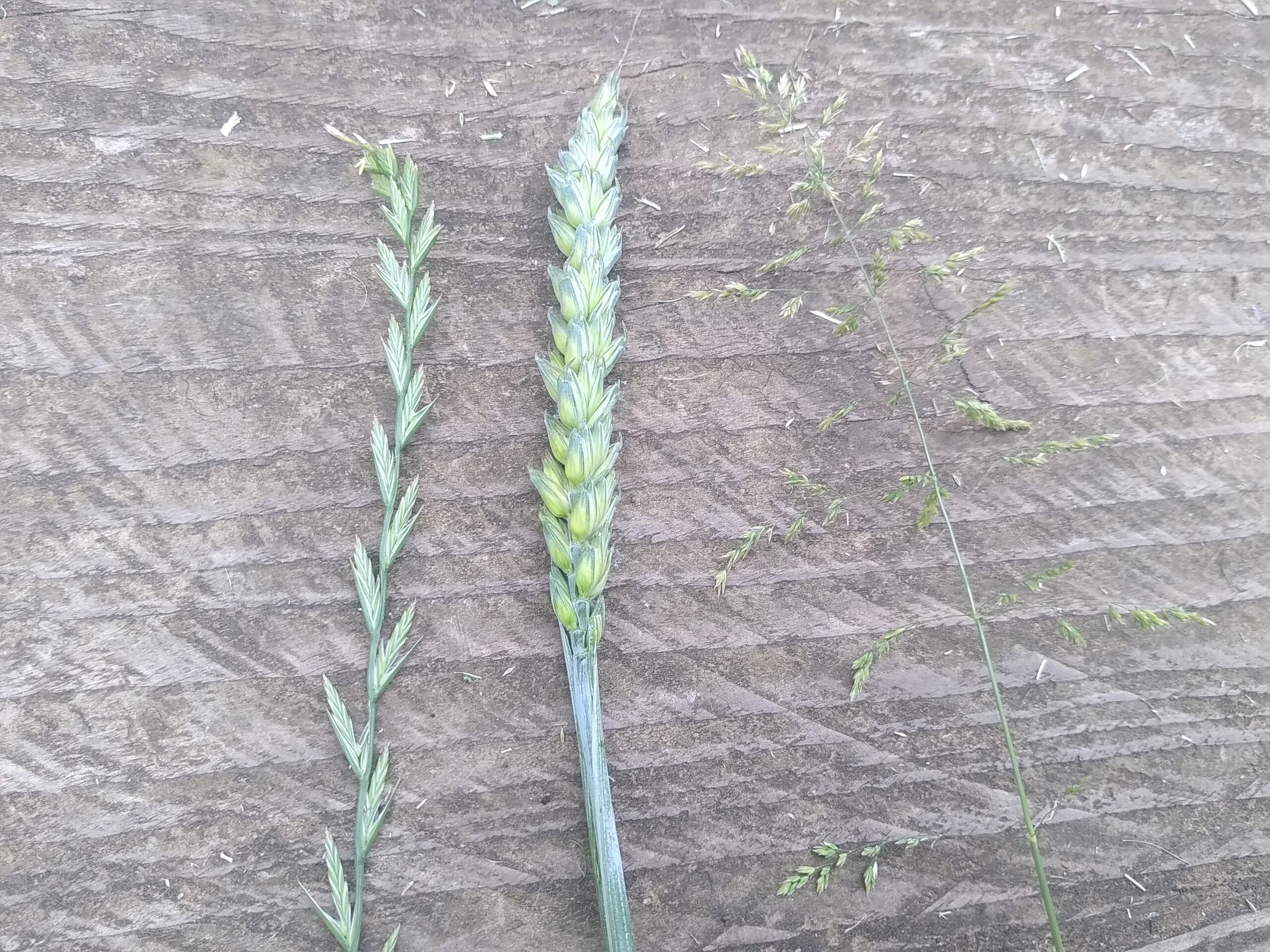
Two wild perennial grasses flanking a domesticated annual grass. An unfair comparison, perhaps. But as I said above, if we want a walk on the wild side to go well, we need to lower our expectations, and share nicely.

If you like my writing, please help me keep the blog going by donating!
 Subscribe via RSS
Being on the other side of the pond, my understanding of the details on Brexit, and how it has played out in the papers as well as in reality is a bit weak.
That said, my take is that we are coming to that point where the pie is no longer getting larger, the number of mouths to feed continues to grow, and as complex supply chains start unraveling and discontent grows, we will begin serious relocalization.
The global economy was never very equitable, as gini indexes and disparate standards of living would confirm. Davos parties and G7 huddles seem to be about maintaining the status quo, especially for retaining power and wealth where it currently resides.
We are reaching the point where there will be no cavalry coming to the rescue, international cooperation and relief organizations will wither, and while there are no solutions to much of what looms, the responses will have to be crafted locally, so maybe for the wrong reasons, Brexit was a hasty grab at a touted solution, but also unintentionally a baby step toward the inevitable endpoint of local self reliance.
No question that the period of relative stability has been ending for a while, but the pace is quickening.
I’ve been thinking lately that our ( U.S.) own embarrassing but disastrous self inflicted end of empire ( I don’t think I need to name names) may actually hasten decline and reduce the further despoiling the planet faster than otherwise. So, a silver lining of sorts.
Just finished reading the book about Rudolph Diesel, and the seismic shift in man’s ability to harness fossil energy and alter the planet. The Diesel powered global economy has been around for a tad over 200 years, and we think this is ” NORMAL” ???
Our Juneberries are almost ripe, and the apple trees look to have set a lot of fruit this year. The cherry trees are a bust, I have no idea why.
Our neighbors who are now pasturing sheep in our field hosted a “Shepherdess workshop” today, with over 40 women in attendance. I’m seeing a continual shift in our hilly region to pasturing sheep, goats, and cattle on fields that should never have been tilled in the first place.
Glimmers of hope.
If we ever do get a Brentry referendum, how I vote might depend on the particular terms, as well as how I feel my vote might embolden or discourage the far right.
I largely agree that Brexit was/is a symptom of political malaise. I sometimes find it helpful to think of these sorts of things as self-reinforcing feedback cycles rather than linear cause and effect; Brexit may not be a root cause of our malaise, but that doesn’t mean it didn’t make things worse in some pretty tangible ways (I know you aren’t denying this, but… sometimes people do.)
Nostalgia for the Before Times is an interesting one, but maybe it’s just another manifestation of eschatology. I’m a bit too Anglican to really pin everything on those pesky Protestants without instantly becoming laughable. Instead, if I’m honest with myself, my nostalgic yearning is for something none of us remember and which is written in various creation myths, not in historical accounts. If I have an impulse to go back anywhere, it’s to the garden of Eden, to a blissful existence before pain or death. That seems unlikely, even within the same religious framework: the risen Christ bears the marks of the Crucifixion. Suffering can be redeemed, transformed, even healed and glorified — but not undone.
I think brexit was the population grasping for growth , they watched their industries die and blamed the eu , they saw the EU as a burocratic menace , they got something as bad but home grown and Brussels educated . A industrial economy with no cheap energy is a recipe for disaster , Europe is on the long slippy slope to irrelevance , and it seems that food is going the same way , get cheap food from anywhere !! to hell with pesticides and drug legislation ,it must be cheap to fend off the pitchforks , the hard fought safety measures will be slowly a d inevitably dropped . Tax everything in sight causing a death spiral as the producers that can are leaving for greener pastures , we see this in CA / the west coast and the city of New York , UK farmers assets are stuck in the UK and those assets will end up in the hands of foreign investors headquartered in tax free countries and will pay little tax to the Treasury .
That is a great image of the grasses, on many levels.
Thanks for the comments – little to add. It’d be nice if public understandings around farming in Britain could encompass pasturing ruminants as a good thing! Especially in lowland arable areas. And could also encompass the idea that making farming even more parlous economically is not a good thing. Meanwhile, let’s hear it for horticulture. The home garden or market garden as a step on the treacherous road to Eden
Just to add (1) nice to see you here again Greg, and (2) Re Steve C’s comment about not naming names, my son told me he passed a group of US visitors in a remote part of Scotland recently who said ‘Just so you know dude, we didn’t vote for the psycho’. Maybe we’ll all be finding ourselves saying that more often in the future.
Wonder which psycho Trump the billionaire or Biden afflicted with altzheimers .
Seems the world has another burr under its saddle , Dart moor ponies being culled because of too much grass , then you have Australia culling brumbies ( wild horses ) because of environmental damage ( no grass ) then the USA culling wild horses because of desertification ( no grass over grazing ) ponies have been on Dartmoor a long time , horses in the US and Australia are introduced .
We have a lot of ” market gardens ” in another month or so there will be peaches apricots ,plums in abundance , Mellon , squash okra , beans and peas , what we don’t have is potatoes , apples , salad crops , too hot for them this time of year , signs are being dusted off and touched up ready for the roadside stand .
Chris wrote: “The example of poorer countries to the east assiduously courting the EU to improve their economies, although perhaps not their agricultures, might have held some lessons, but they were lost on us.”
The EU member country which seems the most Small-Farm-Future-ready is Romania. But since joining the EU in 2007, the subsistence abilities of Romania’s population is being eroded away, as policies attempt to reduce the “fragmentation” of agricultural land (instead of the more resilient path of effectively increasing fragmentation by making farmland available to more people).
From 2007 to 2020, Romania’s agricultural holdings decreased from 3.9 million to 2.9 million, a reduction of one million separate farms (for a population of 19 million). During those years of EU membership, Romania’s farmed area was reduced by 1 million hectares, leaving 12.8 million hectares of farmed land in 2020.
That still leaves around 1 farm for every 6 people in the country, with an average farm size of 4.4 hectares (11 acres), even though half the farms are smaller than 1 hectare (2.5 acres).
Semi- subsistence Farming in Romania and Bulgaria: a Survival Strategy?
Carmen Hubbard, Plamen Mishev, Nedka Ivanova and Lucian Luca
https://www.researchgate.net/profile/Carmen-Hubbard/publication/261476597_Semi-subsistence_Farming_in_Romania_and_Bulgaria_A_Survival_Strategy/links/6501e7858d6da36cc877d119/Semi-subsistence-Farming-in-Romania-and-Bulgaria-A-Survival-Strategy.pdf
Additional reference:
“In 2020, there were 2887 thousand agricultural holdings cultivating 12.8 million hectares of land. Of these, 54% were smaller than 1 ha.”
Vol. 71, No. 3 / 2023 INMATEH – Agricultural Engineering
TOWARDS SUSTAINABLE SUBSISTENCE AGRICULTURE IN ROMANIA WITH LOW-
COST IoT MODULES AND SOLUTIONS – PROOF OF CONCEPT
Ştefania-Adriana HOŢEI et al.
There is a very real demographic shift that happened in the UK after Brexit. It is not just economic and political. It is also social. I spent three weeks in the highlands and islands of Scotland before the Brexit vote in 2016. I attended the Orkney Folk Festival in Stromness, did a week of WOOFing (Worldwide Workers on Organic Farms) in the Orkneys, visited Inverness, Culloden and the neolithic site down the hill from the battle site; plus I visited the Shetland Isles and the Isle of Skye. My on-the-ground observation was that Brexit was a foregone conclusion. Later I was surprised to hear that, overall, Scotland actually voted to Remain. Thus the skepticism of biased samples, no matter the size of the sample. (My margin of error was huge, of course.) My take on the situation in the UK after the Brexit results were published was that the UK had a wonderful opportunity to relocalize. And of course the UK blew it. Probably any country would blow it in the same situation. (Another problem with state-level society – lack of ability to adapt.)
I have seen demographic shifts in action since 1966 in the US and since 2018 in France. They are a real thing and not just some add-on description. The question is: “How do I use the demographic shifts to my advantage? How do I get ahead of the game?” My working model right now is Anticipation. In other words, how do we “anticipate” the demographic shift? And this is not some airy-fairy construct, whether from left or right, that we “create” our own reality. Quite the opposite. There are things going on under the surface, as well as right in front of us. So here is the plan.
1) Observe what is right in front of you. Be precise. No waffling.
2) Anticipate where that could go.
3) Look at what actions could work in synchronicity with the flow that you see unfolding.
4) Do the work.
Just a question , several of my UK friends tell me that the new PM has nationalizing all farm land on his agenda .
To Diogenese10
Andy Burnham has not proposed nationalising farm land. He has mentioned reforming land taxation and supporting family farms. As farm land is not taxed in the UK except for inheritance purposes I can only presume that he is going to alter the inheritance tax rules with regard to a currently sustainable family farm i.e raise the ceiling at which inheritance tax is paid. One of the rules of politics PM Starmer forgot or never learned is don’t pick fights with people who have a broad constituency when you don’t have too. Farmers, though small in number tap into a broader rural constituency. Though there is a lot of wealth in the countryside this is wealth that has come in from the outside with the effect of inflating property prices when agriculture has been in a depression for thirty years plus. The traditional rural economy of small shops, pubs, and mechanics that supported farming have declined as much as farming. The result is that a tax hikes for farmers are seen as unjust, not just by farmers but by the wider rural society. Messing with the subsidy schemes that provide farmers with money for environmental work has further eroded farmers trust in government.
We will see if Andy Burnham has better political sense.
T Y for the info .
I just watched this video, “No, the UK Is Not Going to Rejoin the EU.” It is by TLDR News and the link is here. https://www.youtube.com/watch?v=9iqZaE9fC7o&t=314s
What I didn’t know is that 2/3 of the EU fees were waived for the UK’s participation and it is unlikely the EU would give the UK the same kind of deal to rejoin. This is significant money. Oops.
web.archive.org/web/20260627050122/https://www.rt.com/business/642232-volkswagen-close-german-factories/
Seems like rejoining Europe is a looser , if VW can’t make a go of it the UK with higher energy costs don’t have a chance . In other news the Germans have halted tank production because Sweden can’t supply enough steel ( Germany can’t produce enough ) the EU pipe dream of fighting Russia is rapidly becoming just that , A pipe dream .